
Mystacides
Berthold, 1827
long-horned caddisflies
Species Guides
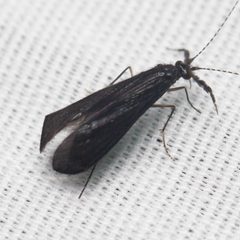
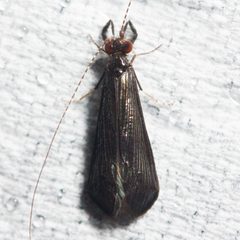
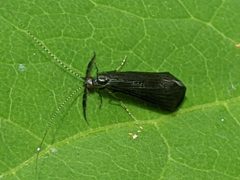
3- Mystacides alafimbriatus(long-horned caddisfly)
- Mystacides interjectus(Gold-winged Long-horned Caddisfly)
- Mystacides sepulchralis(black dancer)
Mystacides is a of in the Leptoceridae, commonly known as long-horned caddisflies. The genus contains at least 20 described distributed across North America and Eurasia. are characterized by exceptionally long , often exceeding body length. Larvae construct portable cases from sand grains and plant fragments.
Pronunciation
How to pronounce Mystacides: //mɪsˈtæ.sɪˌdiːz//
These audio files are automatically generated. While they are not always 100% accurate, they are a good starting point.
Identification
distinguished from other Leptoceridae by that are notably longer than the body. Mystacides longicornis adults exhibit two wing forms: one with dark bands on a fawn background, the other with plain brown wings. Additional identifying features include red and black hairy maxillary palps that protrude outward. Larval cases are straight or slightly curved, composed of sand grains and plant fragments. Larval identification within the is complicated by considerable morphological variation, which has historically caused misidentification.
Images
Habitat
Both still and flowing freshwater . of M. longicornis fly from May to September.
Distribution
Widespread across North America and Eurasia. M. longicornis is widespread and very common in England and Wales, less common in Scotland, and widespread in Europe. M. azureus has been confirmed in Georgia. North American records include Vermont and other US localities.
Seasonality
active May to September (based on M. longicornis).
Diet
Larvae .
Life Cycle
Larvae construct portable cases from environmental materials.
Behavior
Larval cases often have fragments projecting beyond the case margin, presumably as a deterrence mechanism making the case more difficult to swallow.
Similar Taxa
- Other LeptoceridaeMystacides distinguished by length exceeding body length, whereas related typically have shorter antennae relative to body size.
Sources and further reading
- BugGuide
- Wikipedia
- GBIF taxonomy match
- iNaturalist taxon
- NCBI Taxonomy
- Catalogue of Life
- A COMPARATIVE STUDY OF THE NORTH AMERICAN SPECIES IN THE CADDISFLY GENUS MYSTACIDES (TRICHOPTERA: LEPTOCERIDAE)
- The first record of Calamoceras illiesi Malicky & Kumanski, 1974 (Trichoptera, Calamoceratidae) and confirmation of the occurrence of Mystacides azureus Linnaeus, 1761 (Trichoptera, Leptoceridae) from Georgia
- The genome sequence of a cased caddisfly, Mystacides longicornis (Linnaeus, 1758).