
Psychomyia flavida
Hagen, 1861
Dinky Net-tube Caddisfly
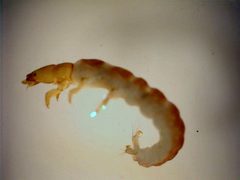
Psychomyia flavida is a of caddisfly in the Psychomyiidae, described by Hagen in 1861. It is commonly known as the Dinky Net-tube Caddisfly. The species belongs to a family characterized by larvae that construct fixed, net-like retreats for filter feeding. As a member of the order Trichoptera, it shares traits with other caddisflies including aquatic larval stages and terrestrial stages.
Pronunciation
How to pronounce Psychomyia flavida: //saɪˈkoʊ.mi.ə ˈflæv.ɪ.də//
These audio files are automatically generated. While they are not always 100% accurate, they are a good starting point.
Images
Habitat
Larvae of Psychomyia construct fixed retreats on submerged surfaces in flowing water, typically attaching silk nets to rocks or woody debris. The specific requirements for P. flavida are not documented in available sources.
Distribution
North America; Nearctic region. The has been recorded as present in North America based on distribution data from GBIF.
Life Cycle
Like other Psychomyiidae, P. flavida likely has an aquatic larval stage that constructs a fixed retreat and filter-feeds, followed by within or near the retreat, and of winged . Specific details for this are not documented.
Behavior
are likely and attracted to light, as is common in the order Trichoptera. Larvae construct fixed net-tube retreats attached to substrate in flowing water, using silk to create a funnel-shaped structure for capturing food particles.
Ecological Role
Larvae function as collector-filterers in aquatic , processing fine particulate organic matter. They serve as food sources for fish and other aquatic .
Human Relevance
May be used as bioindicators of water quality in freshwater systems, as are many Trichoptera . No specific economic or medical importance documented.
Similar Taxa
- PsychomyiaOther in the Psychomyia share similar net-tube retreat building and general ; species-level identification requires examination of genitalia and other detailed morphological features.
- Other Psychomyiidae genera (e.g., Tinodes, Lype)These also construct fixed retreats but differ in retreat architecture, larval case structure, and morphological details such as wing venation and genitalia.
More Details
Taxonomic notes
The was described by Hagen in 1861. The 'Dinky Net-tube Caddisfly' appears in iNaturalist records, though its origin and widespread usage are not documented in formal taxonomic literature.
Data availability
As of available sources, there are only 10 iNaturalist observations and limited published biological studies specifically targeting this . Most biological knowledge is inferred from -level characteristics.