
Lype diversa
(Banks, 1914)
net tube caddisfly
Lype diversa is a of net tube caddisfly in the Psychomyiidae, first described by Nathan Banks in 1914. It is a small, inconspicuous caddisfly found in freshwater across North America. Like other members of its family, larvae construct silken capture nets to filter food particles from flowing water. The species is among the least documented in its , with sparse occurrence records and limited ecological study.
Pronunciation
How to pronounce Lype diversa: /ˈlaɪpi dɪˈvɜːsə/
These audio files are automatically generated. While they are not always 100% accurate, they are a good starting point.
Identification
of Lype diversa are small , typical of the Psychomyiidae , with reduced wing venation and a generally drab, brownish coloration. The Lype can be distinguished from related genera in Psychomyiidae by genitalic characters, particularly the structure of the male claspers and the shape of the female terminalia. -level identification within Lype requires examination of these genitalic structures; L. diversa is distinguished from by specific configurations of the male inferior appendages and the female subgenital plate as described in the original species description.
Images
Habitat
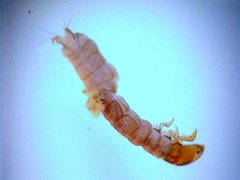
Larvae inhabit flowing freshwater , particularly small streams and seeps, where they construct silken nets on the undersides of stones and other submerged substrates. These nets serve as both shelter and food-capture devices, filtering organic particles and small from the current.
Distribution
North America; documented from the northeastern United States including Vermont, with broader distribution across the Nearctic region.
Behavior
Larvae are filter-feeders, remaining within their constructed silken nets to capture food particles from flowing water. are short-lived and primarily focused on ; they are weak fliers typically found near larval .
Ecological Role
Larval filter-feeding contributes to organic matter processing in headwater stream . As prey for aquatic and terrestrial , the participates in energy transfer between aquatic and riparian .
Similar Taxa
- PsychomyiaAlso in Psychomyiidae with similar net-building larvae; distinguished by wing venation and genitalic characters, particularly the shape of the male tenth tergite and phallic apparatus.
- TinodesAnother psychomyiid with comparable preferences; Tinodes generally have more elaborate wing fringes and different net architecture.