
Potamyia
Banks, 1900
netspinning caddisflies
Species Guides
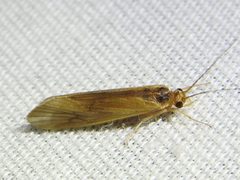
1- Potamyia flava(Yellow Net-spinning Caddisfly)
Potamyia is a of netspinning in the Hydropsychidae, containing more than 20 described . Larvae are aquatic and inhabit streams, with five instars characterized by progressive increases in capsule width. They are filter-feeders that consume diatoms, green , filamentous algae, detritus, and fragments. The genus is distributed across Asia, with documented species in Thailand, China, and other regions.
Pronunciation
How to pronounce Potamyia: //poʊˈtæ.mi.jə//
These audio files are automatically generated. While they are not always 100% accurate, they are a good starting point.
Images
Habitat
Streams, including montane streams. Larvae are aquatic and construct retreats in flowing water.
Distribution
Asia: documented in Thailand (western and southern regions), China, and other Asian localities.
Seasonality
collected in February, May, and December in western Thailand.
Diet
filter-feeders. Gut contents include primarily diatoms and green , followed by filamentous algae, detritus, and fragments.
Life Cycle
Larvae undergo five instars. capsule widths: first instar 0.20–0.29 mm, second instar 0.30–0.39 mm, third instar 0.40–0.59 mm, fourth instar 0.60–0.79 mm, fifth instar 0.80–1.15 mm.
Behavior
Netspinning: larvae construct silk retreats and capture nets in flowing water to filter food particles.
Ecological Role
Aquatic primary consumers and ; contribute to nutrient cycling in stream through filter-feeding activity.
More Details
Molecular identification
Larvae of Potamyia chinensis have been successfully associated with using mitochondrial COI barcodes and nuclear ribosomal 28S D2 genes. These markers were congruent for boundaries across 11 haplogroups, though 28S D2 failed to differentiate some closely related species.
Taxonomic note
Potamyia echigoensis was recently synonymized with P. chinensis.
Sources and further reading
- BugGuide
- GBIF taxonomy match
- iNaturalist taxon
- NCBI Taxonomy
- Catalogue of Life
- The larvae of Chinese Hydropsychidae (Insecta: Trichoptera), Part II: Potamyia chinensis and Cheumatopsyche trifascia
- Description of the larva and pupa of Potamyia phaidra Malicky and Chantaramongkol (Trichoptera: Hydropsychidae) from southern Thailand
- The larva and pupa of Potamyia flavata (Banks 1934) (Trichoptera: Hydropsychidae): Description, life cycle, and notes on its biology