
Elenchus koebelei
(Pierce, 1908)
Elenchus koebelei is a of twisted-wing in the Elenchidae. It is a of Prokelisia, a of planthoppers in the family Delphacidae. The species has been documented in Florida salt marshes. As a member of Strepsiptera, it exhibits the extreme and endoparasitic lifestyle characteristic of this order.
Pronunciation
How to pronounce Elenchus koebelei: //ɛˈlɛn.kʊs koʊˈɛb.li.aɪ//
These audio files are automatically generated. While they are not always 100% accurate, they are a good starting point.
Identification
Distinguished from other Elenchus by association with Prokelisia and geographic restriction to Florida salt marshes. Males can be identified to Elenchidae by the 4-segmented and specific wing venation patterns. Females are not free-living and can only be identified through molecular analysis or association with males from the same host individual.
Images
Appearance
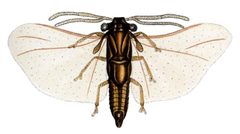
males possess large, fan-shaped hindwings and reduced, club-like forewings (pseudohalteres). The are (meeting dorsally) and composed of few large . Females are , wingless, and legless, remaining within the . Body form is typical of Elenchidae, with males showing the characteristic strepsipteran body plan of reduced mouthparts and branched .
Habitat
Florida salt marshes. Specific microhabitat requirements are tied to the Prokelisia, which inhabits salt marsh vegetation.
Distribution
Known from Florida, USA. Distribution is likely limited by the range of its Prokelisia in coastal salt marsh .
Host Associations
- Prokelisia - of planthoppers (Delphacidae) inhabiting salt marshes
Life Cycle
Strepsipteran involves triungulin larvae that actively seek , followed by endoparasitic development. Males pupate and emerge as free-living ; females remain within the host, releasing larvae through a opening. Specific details for E. koebelei are not documented.
Behavior
Males are short-lived and do not feed as . They seek females within insects for mating. Triungulin larvae display active host-seeking .
Ecological Role
of Prokelisia planthoppers in Florida salt marsh . Potential influence on in this specialized .
Human Relevance
No documented direct human relevance. May contribute to natural of planthopper in coastal wetlands.
Similar Taxa
- Other Elenchus speciesShare -level characteristics including associations with planthoppers; distinguished by host and geographic distribution
- Other Strepsiptera families (e.g., Stylopidae)Different associations (bees/ for Stylopidae) and morphological details of male genitalia and wing structure
More Details
Taxonomic history
Originally described as Mecynocera koebelei by Pierce in 1908, later transferred to Elenchus.