
Psocathropos lachlani
Ribaga, 1899
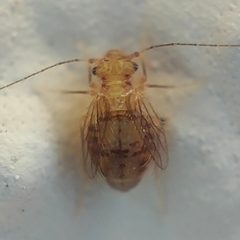
Psocathropos lachlani is a of troglomorphic barklouse in the Psyllipsocidae, characterized by reduced and elongated associated with cave-dwelling habits. The species exhibits a remarkably broad global distribution spanning six continents, including both native cave and human-associated environments. It is frequently encountered in settings such as buildings, cellars, and stored products, facilitating its anthropogenic worldwide. The species is one of the most widely distributed , with records from Mediterranean Europe, Africa, the Americas, Asia, and Oceania.
Pronunciation
How to pronounce Psocathropos lachlani: /soʊkəˈθroʊpɒs ləˈklɑːni/
These audio files are automatically generated. While they are not always 100% accurate, they are a good starting point.
Identification
Distinguished from other Psocathropos by the combination of reduced , long , and specific genitalic structures (male hypandrium and female gonapophyses). Separated from surface-dwelling by the absence or strong reduction of eyes and pale coloration. Differs from other troglomorphic psyllipsocids by details of wing venation when wings present, and by geographic distribution pattern. Identification to species level requires microscopic examination of genitalia.
Images
Habitat
Primarily caves and subterranean environments; also commonly found in including buildings, cellars, warehouses, greenhouses, and stored food products. Has been observed in bird nests.
Distribution
Widely distributed across six continents: native range includes Mediterranean region (Italy, Morocco, Canary Islands, Madeira); established in Middle East (Bahrain, Israel), Africa (Angola, Cameroon, Congo, Madagascar, Mozambique, Nigeria, Tanzania, Mascarene Islands, Zanzibar), Americas (USA, Caribbean, Mexico, Central America, Brazil, Colombia), Asia (China, India, Indonesia, New Guinea, Taiwan, Thailand), and Oceania (Australia, Hawaii, Ascension Island). The distribution pattern indicates extensive anthropogenic .
Diet
Feeds on organic detritus, fungal , and spores; in cave environments, consumes guano and other organic accumulations.
Behavior
Gregarious; forms in suitable microhabitats. Active year-round in stable cave and indoor environments.
Ecological Role
Decomposer in cave ; contributes to nutrient cycling through consumption of organic matter and fungi.
Human Relevance
Common pest of stored products and buildings; frequently recorded from food storage facilities, grain warehouses, and domestic dwellings. Transported globally through human commerce.
Similar Taxa
- Psocathropos micropsSimilar troglomorphic ; distinguished by details of male genitalia and geographic distribution.
- Psyllipsocus ramburiiOverlaps in ; has fully developed and shorter , and shows different wing reduction patterns.
- Trogiomorpha psocidsBroad group including other cave-dwelling ; P. lachlani distinguished by -level characters of Psyllipsocidae including specific pretarsal claw structure.
More Details
Taxonomic note
Authorship sometimes cited as Ribaga, 1901, but original description is from 1899. The has been frequently misidentified in literature due to morphological similarity to other troglomorphic psyllipsocids.
Dispersal mechanism
The global distribution pattern, including oceanic islands without native cave systems, demonstrates human-mediated transport. The has likely been introduced repeatedly through shipping and commerce over the past century.