
Neoperla
Needham, 1905
Tropical Stoneflies
Species Guides
3- Neoperla clymene(Coastal Stone)
- Neoperla coosa(Coosa stone)
- Neoperla mainensis(Maine Stone)
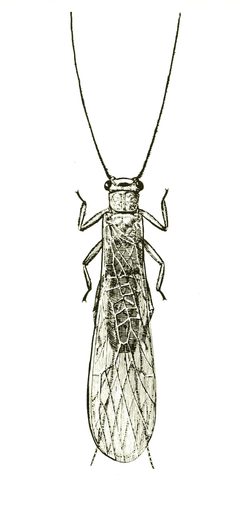
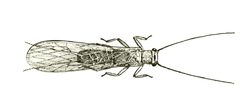
Neoperla is a large of stoneflies in the Perlidae, with over 270 described worldwide. It is the most species-rich genus in Perlidae, exhibiting exceptional diversity in Asia where China alone over 100 species. The genus has a broad intercontinental distribution spanning eastern North America, tropical and temperate Asia, and sub-Saharan Africa. Species identification relies heavily on male genitalia , particularly the highly differentiated structure.
Pronunciation
How to pronounce Neoperla: /niːoʊˈpɜːrlə/
These audio files are automatically generated. While they are not always 100% accurate, they are a good starting point.
Identification
-level identification within Neoperla requires examination of male genitalia, specifically the base and everted , which provide the most important diagnostic characteristics. The of these structures is highly differentiated between species. General Perlidae traits apply: medium to large stoneflies with two ocelli, gills absent on , and wings held flat over body at rest.
Images
Habitat
Riverine freshwater . Specimens have been collected from rivers and streams within national nature reserves, including Dasha River National Nature Reserve, Maolan National Nature Reserve (Sancha River), Danjiang Village, Chebaling National Nature Reserve, Jiulianshan National Nature Reserve, and Yingzuijie National Nature Reserve in China.
Distribution
Eastern North America, tropical and temperate Asia, and central Africa. Asia: China (over 100 ), Vietnam, Thailand, Mongolia, Indian Subcontinent, Malesia. Africa: sub-Saharan Africa with 82 species. North America: eastern United States including species such as Neoperla clymene and Neoperla coosa.
Behavior
have been observed to be attracted to light traps and captured in , indicating or activity patterns.
Similar Taxa
- Other Perlidae generaNeoperla can be distinguished from other perlid by specific male genitalia characteristics, particularly . Within Perlidae, generic boundaries are primarily defined by these structures rather than general body form.
More Details
Species richness
Neoperla is among the most -rich of stoneflies globally, with at least 271 described species and ongoing taxonomic work continuing to expand this number.
Taxonomic importance
The serves as a significant subject for biogeographic and phylogenetic studies due to its wide distribution across multiple continents and high .
Sources and further reading
- BugGuide
- Wikipedia
- GBIF taxonomy match
- iNaturalist taxon
- NCBI Taxonomy
- Catalogue of Life
- Redescription of two species of Neoperla Needham, 1905 (Plecoptera, Perlidae) and new distribution records of Neoperla mnong Stark, 1987 in China
- Figure 7 from: Zeng L-L, Huo Q-B, Du Y-Z (2024) Redescription of two species of Neoperla Needham, 1905 (Plecoptera, Perlidae) and new distribution records of Neoperla mnong Stark, 1987 in China. Biodiversity Data Journal 12: e127089. https://doi.org/10.3897/BDJ.12.e127089
- Figure 5 from: Zeng L-L, Huo Q-B, Du Y-Z (2024) Redescription of two species of Neoperla Needham, 1905 (Plecoptera, Perlidae) and new distribution records of Neoperla mnong Stark, 1987 in China. Biodiversity Data Journal 12: e127089. https://doi.org/10.3897/BDJ.12.e127089
- Figure 1 from: Zeng L-L, Huo Q-B, Du Y-Z (2024) Redescription of two species of Neoperla Needham, 1905 (Plecoptera, Perlidae) and new distribution records of Neoperla mnong Stark, 1987 in China. Biodiversity Data Journal 12: e127089. https://doi.org/10.3897/BDJ.12.e127089
- Figure 4 from: Zeng L-L, Huo Q-B, Du Y-Z (2024) Redescription of two species of Neoperla Needham, 1905 (Plecoptera, Perlidae) and new distribution records of Neoperla mnong Stark, 1987 in China. Biodiversity Data Journal 12: e127089. https://doi.org/10.3897/BDJ.12.e127089
- Figure 8 from: Zeng L-L, Huo Q-B, Du Y-Z (2024) Redescription of two species of Neoperla Needham, 1905 (Plecoptera, Perlidae) and new distribution records of Neoperla mnong Stark, 1987 in China. Biodiversity Data Journal 12: e127089. https://doi.org/10.3897/BDJ.12.e127089
- Figure 2 from: Zeng L-L, Huo Q-B, Du Y-Z (2024) Redescription of two species of Neoperla Needham, 1905 (Plecoptera, Perlidae) and new distribution records of Neoperla mnong Stark, 1987 in China. Biodiversity Data Journal 12: e127089. https://doi.org/10.3897/BDJ.12.e127089
- Figure 3 from: Zeng L-L, Huo Q-B, Du Y-Z (2024) Redescription of two species of Neoperla Needham, 1905 (Plecoptera, Perlidae) and new distribution records of Neoperla mnong Stark, 1987 in China. Biodiversity Data Journal 12: e127089. https://doi.org/10.3897/BDJ.12.e127089
- The mitochondrial genome of Neoperla bimaculata (Li et al. 2021) (plecoptera: perlidae) from Tibet of southwest China and its phylogenetic analysis.