
Leuctra
Stephens, 1836
rolled-winged stoneflies
Species Guides
8- Leuctra duplicata(Atlantic Needlefly)
- Leuctra ferruginea(Eastern Needlefly)
- Leuctra laura(Hampshire needlefly)
- Leuctra sibleyi(Brook Needlefly)
- Leuctra tenella(Broad-lobed Needlefly)
- Leuctra tenuis(Narrow-lobed Needlefly)
- Leuctra truncata(Truncate Needlefly)
- Leuctra variabilis(variable needlefly)
Leuctra is a of rolled-winged stoneflies ( Leuctridae) containing at least 210 described . Nymphs develop in freshwater or brackish water , with emerging in summer months. Some species exhibit unusual cycles between coastal marine areas and freshwater streams. The genus serves as an important bioindicator of water quality and landscape disturbance.
Pronunciation
How to pronounce Leuctra: /ˈlɛwktrə/
These audio files are automatically generated. While they are not always 100% accurate, they are a good starting point.
Identification
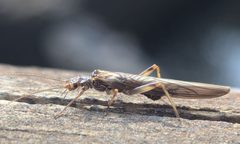
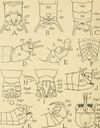
distinguished from other by wings rolled around the body at rest. -level identification in males relies on genitalic structures: shape of teeth on tergite VIII, lateral edges of tergites, and expansion of paraprocts. Genetic differentiation between closely related species is substantial (approximately 9% interspecific distance versus <1% intraspecific).
Images
Appearance
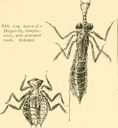
have wings that roll around the body when at rest, giving the "rolled-winged stoneflies." Males of some possess diagnostic morphological features including two teeth on tergite VIII with characteristic shapes, distinct lateral edges of tergites, and expanded portions of paraprocts. Nymphs are aquatic with typical body plan adapted to benthic environments.
Habitat
Freshwater streams and rivers; some develop in brackish coastal waters. Eastern Ohio associated with forested landscapes and high-quality streams. One species (L. digitata) exhibits a cycle between coastal streams and adjacent coastal marine areas.
Distribution
Holarctic distribution with records from East Europe, Siberia, Russian Far East, China, and North America (e.g., Alabama, Ohio). L. biellensis occurs on the southern slope of the Alps in Italy and Switzerland; L. nigra distributed across Central and Northern Europe. L. jiuhuashana recently described from Anhui Province, China, representing eastern expansion in the Oriental region.
Seasonality
emerge in July and August. Long of 1–2 years reported for some .
Life Cycle
Nymphal development occurs in aquatic environments (freshwater or brackish). are terrestrial. Some complete a cycle: nymphs drift to coastal areas, adults emerge and fly back to streams to oviposit.
Behavior
High drift rates of nymphs towards coastal areas observed in some . capable of between coastal marine zones and freshwater streams for reproductive purposes.
Ecological Role
Bioindicator of river water quality and general landscape disturbance. Presence indicates high-quality aquatic with minimal anthropogenic impact.
Human Relevance
Used by scientists and conservation organizations to prioritize stream protection efforts. Over 17% of Ohio considered rare (known from one or two locations), making them conservation priorities. Anglers model fishing flies after stoneflies.
Similar Taxa
- Other Leuctridae generaLeuctra distinguished within by specific combinations of wing venation and genitalic characters; other lack the diagnostic male tergite VIII and paraproct
- Other Plecoptera familiesLeuctridae (including Leuctra) uniquely possess wings that roll around the body at rest; other hold wings flat or tent-like over body
More Details
Taxonomic complexity
boundaries historically confused; molecular data (COI genetic distances ~9%) now support separation of cryptic species such as L. biellensis from L. nigra.
Conservation status
Several in Ohio not collected for 50–60 years despite historical records, suggesting local extinction risk due to long times and sensitivity.
Sources and further reading
- BugGuide
- Wikipedia
- GBIF taxonomy match
- iNaturalist taxon
- NCBI Taxonomy
- Catalogue of Life
- Stoneflies mapped across Ohio, with implications for water quality and nature conservation | Blog
- Leuctra, Battle of (371 BCE)
- On the Biology of the Stonefly Species Leuctra digitata in a Northern Swedish Coastal Stream and its Adjacent Coastal Area (Plecoptera: Leuctridae)
- Reinstatement of Leuctra biellensis Festa, 1942 (Plecoptera, Leuctridae)
- The second species of Leuctra Stephens, 1836 (Plecoptera: Leuctridae) from China