
Obolopteryx
Cohn, Swanson & Fontana, 2014
Species Guides
6- Obolopteryx brevihastata(Common Short-wing Katydid)
- Obolopteryx castanea(Chestnut Short-winged Katydid)
- Obolopteryx catinata(Spoon-tailed Short-winged Katydid)
- Obolopteryx emarginata(spoon-tail short-wing katydid)
- Obolopteryx gladiator(Gladiator katydid)
- Obolopteryx oreoeca(Mountain-dwelling Short-winged Katydid)
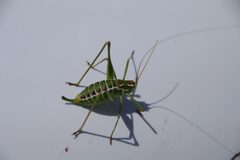
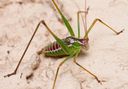
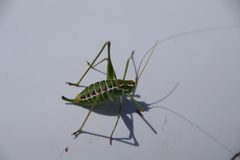
Obolopteryx is a of katydids (bush crickets) to North America, established in 2014 to accommodate previously placed in Dichopetala. The genus currently contains 14 recognized species distributed across the southwestern United States and Mexico. Several species have been described recently from northeastern Mexico, with ongoing taxonomic work revealing and geographic variation within the group.
Pronunciation
How to pronounce Obolopteryx: /ˌoʊbəˈlɒptərɪks/
These audio files are automatically generated. While they are not always 100% accurate, they are a good starting point.
Identification
-level identification relies on male genitalia characters, particularly shape and subgenital plate structure. Males of O. truncoangulata are distinguished from O. brevihastata by a more constricted pronotum mesally, shorter tegmina, and a deeply U-shaped emarginated subgenital plate with excised lateral angles. Females differ in tegmina shape, ovipositor , and basal structure. The as a whole is characterized within Phaneropterinae by features established in the original generic description.
Images
Habitat
have been documented from highland regions of northern Mexico and northeastern Mexico. Specific microhabitat preferences are not well documented in available literature.
Distribution
Southwestern United States (Arizona, New Mexico) and Mexico, including northeastern Mexico, northern highlands, Gulf region, and northwestern areas. GBIF records indicate presence in Arizona, New Mexico, and multiple regions of Mexico.
Similar Taxa
- DichopetalaObolopteryx was established in 2014 to accommodate previously classified in Dichopetala; the type species O. emarginata was originally described as Dichopetala emarginata. The two are distinguished by morphological characters detailed in the original generic description.
More Details
Taxonomic History
The was erected in 2014 by Cohn, Swanson & Fontana, transferring multiple from Dichopetala. Recent descriptions from 2015-2016 have significantly expanded known diversity, with five new species described from northeastern Mexico in 2016 alone. A gynandromorph of O. truncoangulata has been documented from the field.
Polymorphism and Variation
The exhibits and geographic variation, which has complicated delimitation and may have contributed to the relatively recent recognition of distinct species within the group.
Sources and further reading
- BugGuide
- Wikipedia
- GBIF taxonomy match
- iNaturalist taxon
- NCBI Taxonomy
- Catalogue of Life
- Additional new species of the genus Obolopteryx Cohn et al. 2014 (Ensifera: Tettigoniidae) from Northeastern Mexico
- A new species of the genus Obolopteryx Cohn et al. 2014 and a conspecific <br />gynandromorph (Ensifera: Tettigoniidae: Phaneropterinae)