
Allonemobius fasciatus
(De Geer, 1773)
striped ground cricket
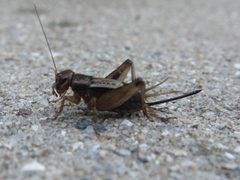
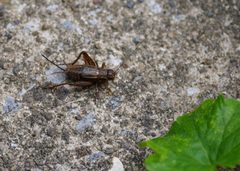
Allonemobius fasciatus, the striped ground , is a small ground-dwelling cricket native to North America. It is a model organism in evolutionary , particularly for studies of hybridization with its sister A. socius, reproductive isolation, and . The species exhibits complex strategies including , where females produce offspring with variable developmental phenotypes to spread risk across unpredictable environmental conditions. show altitudinal adaptation in timing, with photoperiodic regulation of development compensating for shorter growing seasons at higher elevations.
Pronunciation
How to pronounce Allonemobius fasciatus: /ˌæloʊnəˈmoʊbiəs fæʃiˈeɪtəs/
These audio files are automatically generated. While they are not always 100% accurate, they are a good starting point.
Identification
Distinguished from the closely related Allonemobius socius primarily by distribution and preference: A. fasciatus occupies northern regions and higher elevations, while A. socius occurs in southern regions and lower elevations. Where ranges overlap, the two form hybrid zones. Mating calls differ between species and function in species recognition, though calls can be undifferentiated to female receivers. Males of A. fasciatus and A. socius cannot be reliably distinguished morphologically; identification typically requires genetic analysis or examination of calling song characteristics.
Images
Habitat
Short grassland . Found across an altitudinal gradient of at least 1100 m, with at higher elevations adapted to shorter growing seasons through modified timing.
Distribution
Widely distributed in North America, with in eastern and western portions. Occupies northern regions relative to its sister A. socius. Documented hybrid zones occur in areas of range overlap, including New Jersey. In topographically variable regions such as mountains, found at higher elevations compared to A. socius.
Seasonality
with one per year. Hatching time varies by more than 1.5 months across altitudinal gradient. Development speed increases as daylight decreases, indicating seasonal synchrony. activity period varies geographically due to altitudinal and latitudinal effects on growing season length.
Diet
.
Life Cycle
with embryonic . are deposited into soil using an ovipositor; ovipositor length varies geographically and determines egg burial depth. Diapause is temperature-dependent, though eggs rarely exit diapause at high temperatures. Hatching can take up to two months. Nymphal development is photosensitive: development accelerates as daylight decreases. Wing size is determined by during development, with longer daylight periods producing larger wings; most individuals are short-winged. Females produce one per season. strategy produces offspring with variable diapause phenotypes within a single reproductive episode, spreading risk across uncertain future conditions.
Behavior
Males produce mating calls that function in both intraspecific and interspecific recognition. Call characteristics are influenced by temperature and during the nymphal stage. Males typically remain stationary when calling to females. Females deposit pheromonal residues on surfaces. Females are highly motivated to mate and select males based on preferred mating calls. When hybridizing with A. socius, females lose little beyond energy expenditure and risk. is strong: females have high affinity for conspecific sperm, and heterospecific matings rarely produce hybrid offspring despite the potential for interbreeding.
Human Relevance
Studied extensively in evolutionary as a model for speciation, hybridization, reproductive isolation, and . Research on this has contributed to understanding of strategies, altitudinal adaptation, genetic architecture of reproductive barriers, and the dynamics of hybrid zones.
Similar Taxa
- Allonemobius sociusSister with which A. fasciatus hybridizes; distinguished by more southern distribution, lower elevation preference, and different mating call characteristics. Forms hybrid zones where ranges overlap. The two species show partial reproductive isolation through despite the absence of behavioral isolation.
More Details
Subspecies
Two recognized: Allonemobius fasciatus abortivus (Caudell, 1904) and Allonemobius fasciatus fasciatus (De Geer, 1773).
Bet-hedging strategy
-level analysis shows a gradual 35-day transition from direct-developing to over the reproductive season. However, individual females show rapid transitions and high variability in diapause timing, indicating that occurs primarily through among-female variation rather than within-female risk spreading.
Genetic basis of reproductive isolation
involves multiple QTL of generally low to moderate effect, though some large-effect QTL exist in A. socius. QTL are distributed across many markers but cluster on a small number of linkage groups, potentially reflecting the role of the large in prezygotic isolation. Asymmetric effects occur: A. socius have stronger effects in hybrid females, causing hybrids to behave like A. socius in sperm utilization.
Sources and further reading
- BugGuide
- Wikipedia
- GBIF taxonomy match
- iNaturalist taxon
- NCBI Taxonomy
- Catalogue of Life
- Grasshoppers of Colorado
- What do insects do in winter? Migrants in the DMV: Common Buckeye, Junonia coenia, Variegated Fritillary, Euptoieta Claudia, Painted Lady, Vanessa cardui, Large Milkweed bug, Oncopeltus fasciatus — Bug of the Week
- Bugs in Orange and Black II: Large milkweed bug, Oncopeltus fasciatus — Bug of the Week
- Orange and Black II: Milkweed leaf beetle, Labidomera clivicollis; Oleander aphid, Aphis nerii; Milkweed Bug, Oncopeltus fasciatus; Monarch, Danaus plexippus — Bug of the Week
- Bugs in orange and black - Monarch butterfly, Danaus plexippus Milkweed Bug - Oncopeltus fasciatus; Milkweed tiger moth, Euchaetes egle — Bug of the Week
- Orange and Black Bugs- Milkweed leaf beetle, Labidomera clivicollis; Oleander aphid, Aphis nerii; Milkweed Bug - Oncopeltus fasciatus; Monarch butterfly, Danaus plexippus — Bug of the Week
- Bet Hedging and the Diapause Strategies of the Cricket Allonemobius Fasciatus
- Altitudinal adaptation of the life cycle in Allonemobius fasciatus DeGeer (Orthoptera: Gryllidae)
- Mating Behavior Differences and the Cost of Mating in Allonemobius fasciatus and A. socius
- Genetic Architecture of Conspecific Sperm Precedence inAllonemobius fasciatusandA. socius