
Trimerotropis agrestis
McNeill, 1900
toothed field grasshopper, toothed dune grasshopper
Species Guides
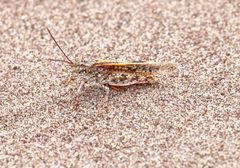
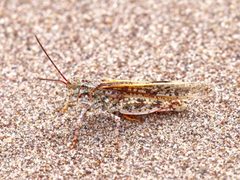
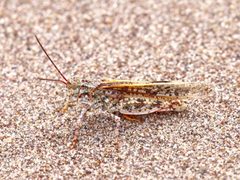
2Trimerotropis agrestis is a band-winged grasshopper in the Acrididae, described by McNeill in 1900. It is native to North America with documented in Colorado, Idaho, and Nebraska. The has been studied for its unusual behavioral , including apparent sex-role reversal in displays and hybridization with Trimerotropis maritima in disturbed .
Pronunciation
How to pronounce Trimerotropis agrestis: /ˌtraɪməˈrɒtrəˌpɪs əˈɡrɛstɪs/
These audio files are automatically generated. While they are not always 100% accurate, they are a good starting point.
Identification
As a member of Trimerotropis, this possesses banded wings typical of the group. Specific diagnostic features distinguishing it from are not documented in available sources. The species name "agrestis" (Latin for "of the field") suggests association rather than morphological trait.
Images
Habitat
Found in open field and dune environments. Has been documented in recently disturbed where it occurs in sympatry with Trimerotropis maritima. Associated with desert grassland based on behavioral studies.
Distribution
North America. Documented occurrence records from Colorado, Idaho, and Nebraska.
Behavior
Exhibits displays that function in reproductive contexts. Studies suggest presumed sex-role reversal in which females may perform aerial typically conducted by males in other . Communicates through species-specific signals, though detailed mechanisms are not extractable from available sources. Hybridization with Trimerotropis maritima has been observed in sympatric .
Similar Taxa
- Trimerotropis maritimaOccurs in sympatry and has been documented to hybridize with T. agrestis in recently disturbed ; requires careful identification where ranges overlap.
- Trimerotropis latifasciataShares -level cryptic coloration adaptations and band-winged ; both utilize camouflage against substrate backgrounds.
More Details
Subspecies
Two are recognized: Trimerotropis agrestis agrestis and Trimerotropis agrestis barnumi.
Behavioral research history
Subject of two-part behavioral study in Animal Behaviour (1970, 1971) examining displays and communication, making it one of the better-studied North for reproductive despite limited ecological data.
Sources and further reading
- BugGuide
- Wikipedia
- GBIF taxonomy match
- iNaturalist taxon
- NCBI Taxonomy
- Catalogue of Life
- Grasshoppers of Colorado
- Species Records and Accounts
- Grasshoppers of Colorado
- Grasshoppers of Colorado
- Grasshoppers of Colorado
- What’s more difficult to see… | Beetles In The Bush
- Apparent Hybridization Between Trimerotropis agrestis and Trimerotropis maritima (Orthoptera: Acrididae) in a Recently Disturbed Habitat
- The behavioural ecology of desert grasshoppers II. Communication in Trimerotropis agrestis
- The behavioural ecology of desert grasshoppers I. Presumed sex-role reversal in flight displays of Trimerotropis agrestis