
Dissosteira spurcata
Saussure, 1884
spurcate grasshopper, pale-winged grasshopper
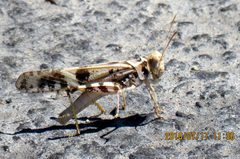
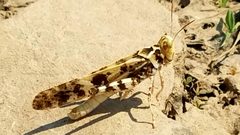
Dissosteira spurcata is a band-winged grasshopper in the Acrididae, commonly known as the spurcate or pale-winged grasshopper. It belongs to a characterized by a high pronotal crest deeply cut by one , slender body form, and medium to large size. The is found in western North America, with records from California and probable occurrence in extreme western Wyoming. It is listed among species of the early hatching group, with nymphs emerging in mid-spring.
Pronunciation
How to pronounce Dissosteira spurcata: //ˌdɪsɒsˈtaɪrə spɜːrˈkeɪtə//
These audio files are automatically generated. While they are not always 100% accurate, they are a good starting point.
Identification
of Dissosteira spurcata can be distinguished from by hindwing coloration and tegmina pattern. Related California include Dissosteira pictipennis and Dissosteira longipennis. As a member of the Oedipodinae (band-winged grasshoppers), it possesses enlarged hindwings for . Nymphs can be identified by diagnostic characters typical of band-winged grasshoppers: height of the carina of the pronotum and number of ; position and length of the lateral carinae; color patterns of the hindlegs; variations in dark bands on the and pronotum; and shape of the foveolae.
Images
Habitat
Inhabits grassland of western North America. Listed among found in grassland and cold desert shrub . Associated with rangeland vegetation in western states.
Distribution
Recorded from California; probable occurrence in extreme western Wyoming. North American distribution in western grasslands.
Seasonality
Early hatching group, with hatching in mid-spring. Nymphal development occurs through spring and early summer, with present in summer months.
Life Cycle
overwinter in soil. Hatching occurs in mid-spring. Nymphs pass through multiple instars (typically five in related Dissosteira ) before reaching adulthood. reproduce in summer, with females depositing egg pods into soil.
Behavior
As a band-winged grasshopper, are capable of strong . Related in the Dissosteira are known for (snapping of hindwings in flight) as a form of . Specific behavioral observations for D. spurcata are limited in available sources.
Ecological Role
Functions as a member of rangeland . Like other grass-feeding or mixed-feeding grasshoppers, it contributes to nutrient cycling and serves as prey for vertebrate and . Specific ecological impact studies for this are not documented in available sources.
Human Relevance
Not among the primary economic pest of western rangelands. Not listed as a serious or occasional pest in Wyoming management assessments. Potential occurrence in extreme western Wyoming suggests it may be encountered in regional biodiversity surveys.
Similar Taxa
- Dissosteira pictipennisCongeneric band-winged grasshopper with similar body plan and preferences; distinguished by hindwing and tegmina coloration patterns
- Dissosteira longipennisCongeneric with similar ; known from eastern Wyoming and western grasslands; distinguished by wing patterns and distribution
- Dissosteira carolinaLarger congeneric (Carolina grasshopper) with black hindwings and yellow margin; more widespread and commonly encountered
More Details
Taxonomic note
Dissosteira spurcata was described by Saussure in 1884. The Dissosteira is characterized by a high pronotal crest deeply cut by one , slender body, and medium to large size.
Data gaps
Detailed biological studies of D. spurcata exist in the literature (e.g., Hilgardia 30(14):395) but specific content on , diet, and reproductive was not accessible in the provided source material. Most information is inferred from -level characteristics and related .
Sources and further reading
- BugGuide
- Wikipedia
- GBIF taxonomy match
- iNaturalist taxon
- Catalogue of Life
- Grasshoppers of Colorado
- Field Guide
- Wyoming Distribution Atlas
- Grasshopper Collections and Survey
- Orangelegged Grasshopper
- Grasshoppers of Colorado
- Biological studies ofDissosteira spurcataSaussure with distributional notes on related California species (Orthoptera-Acrididae)