
Metaleptea
Brunner von Wattenwyl, 1893
clip-wing grasshoppers
Species Guides
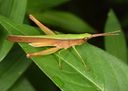
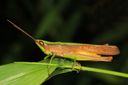
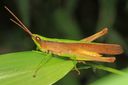
1- Metaleptea brevicornis(clipped-wing grasshopper)
Metaleptea is a of short-horned grasshoppers ( Acrididae) containing at least two described distributed across North, Central, and South America. The genus is characterized by specialized wing structures used in . Males produce three distinct sound types—copulation, rivalry, and —through stridulation of modified hindwing against the forewings. The best-known species, Metaleptea brevicornis, is commonly called the clip-wing .
Pronunciation
How to pronounce Metaleptea: //ˌmɛtəˈlɛptiə//
These audio files are automatically generated. While they are not always 100% accurate, they are a good starting point.
Images
Distribution
North America, Central America, and South America. Specific distribution records include Argentina (northeast and northwest), Bolivia, Brazil (west-central), and Alabama (USA).
Behavior
Males produce three distinct acoustic signals: copulation song, rivalry song, and . All sounds are produced exclusively by males through specialized wing structures. Copulation and rivalry sounds are generated by rubbing subcostal, radial, medial, and cubital 1 of the hindwing against subcostal and radial veins on the underside of the tegmen; the enlarged cubital area of the hindwing acts as a resonator. Crepitation is produced when the expanded of the hindwing cubital area becomes taut. Sound frequencies span 3–4 to 16 kHz with type-specific frequency peaks.
More Details
Etymology of genus name
The name 'Metaleptea' appears to be derived from Greek roots, though the specific etymology is not documented in available sources. The name has been adopted as the title for an orthopteran scientific journal (Metaleptea), published by the Orthopterists' Society.
Acoustic morphology
Sound production in Metaleptea adspersa involves specialized wing venation: the subcostal, radial, medial, and cubital 1 of the hindwing are modified for stridulation against corresponding veins on the tegmen. The expanded cubital area of the hindwing serves a dual function—acting as a resonator for copulation and rivalry songs, and as the direct sound-producing structure for when its is tensed.
Sources and further reading
- BugGuide
- Wikipedia
- GBIF taxonomy match
- iNaturalist taxon
- NCBI Taxonomy
- Catalogue of Life
- Liladownsia fraile: The Rest of the Story
- Ricardo Mariño-Pérez Archives - Entomology Today
- Acoustic behavior ofMetaleptea adspersa(Orthoptera: Acrididae)
- Chiasma Frequency and Distribution in Males and Females of Metaleptea Bremcomis Adspersa (Acridinae, Acrididae) with and without B. Chromosomes