
Tramea carolina
(Linnaeus, 1763)
Carolina Saddlebags
Tramea carolina, commonly known as the Carolina saddlebags, is a native to eastern North America. are recognized by their distinctive wing markings and colored abdominal segments. The species exhibits in coloration, with males displaying brighter red tones. It occupies a range of aquatic and has been observed year-round in southern portions of its range.
Pronunciation
How to pronounce Tramea carolina: /ˈtræmiə ˌkæroʊˈlaɪnə/
These audio files are automatically generated. While they are not always 100% accurate, they are a good starting point.
Identification
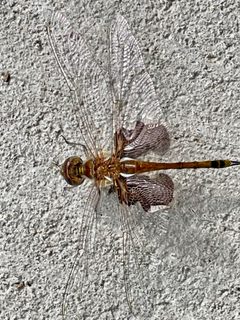
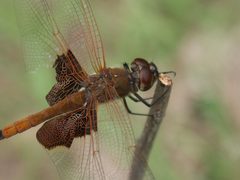
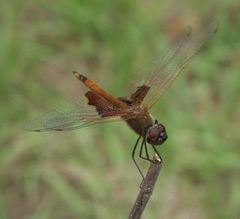
Distinguished from similar Tramea by combination of brown wing bases, black abdominal segments 8–9, and violet forehead markings. Male's entirely violet forehead and bright red coloration separates from females and juveniles. The brown wing bases contrast with the largely clear portions of wings. Size range of 45–54 mm helps distinguish from smaller sympatric skimmers.
Images
Appearance
Medium-sized measuring 45–54 mm in length. and basal portion of each wing are brown. Eighth and ninth abdominal segments are black. present: males have bright red and with entirely violet forehead; females have brownish-red abdomen and face with violet limited to basal portion of forehead. males resemble females in coloration. Wing venation and overall body structure typical of Tramea.
Habitat
Occupies ponds, lakes, swamps, and streams with clear water; explicitly avoided muddy water. Aquatic environments typically support partially or fully submerged vegetation used by larvae. range from permanent water bodies to semi-permanent wetlands with adequate vegetation structure.
Distribution
Eastern North America from southern Nova Scotia south to Florida and Bermuda, west to Texas. Present throughout Caribbean region. Year-round occurrence in Florida; seasonal presence May–August in Canada. GBIF records confirm presence in Vermont and broader North American range.
Seasonality
Active year-round in Florida. In Canada, present May through August. Seasonal activity patterns vary latitudinally, with longer periods in southern portions of range and restricted summer activity in northern .
Diet
are aerial capturing flying insects. Specific prey items not documented in available sources. Larvae are aquatic predators hunting within their submerged environment; detailed prey records not available.
Life Cycle
Hemimetabolous development with aquatic larval stage and terrestrial stage. laid in or near water. Larvae fully aquatic, living in submerged vegetation where they hunt and develop. Duration of larval development not documented. timing varies geographically, corresponding with seasonal water temperatures and .
Behavior
feed in from morning through evening, typically flying 2–7 m above ground surface. Frequently perch on stem tips and elevated objects. Strong, direct with gliding capabilities characteristic of . Larvae remain fully aquatic, active within submerged vegetation.
Ecological Role
function as aerial in terrestrial and freshwater-terrestrial . Larvae serve as aquatic predators within lentic and lotic systems, contributing to regulation in vegetated aquatic .
Human Relevance
No documented direct economic or medical significance. Occasionally encountered by observers of and naturalists. Not known to bite or sting humans. May serve as for healthy aquatic with clear water and submerged vegetation.
Similar Taxa
- Tramea lacerata (Black Saddlebags)Overlaps in range; distinguished by darker overall coloration and different wing patterning with broader black markings at wing bases
- Tramea onusta (Red Saddlebags)Similar size and use; separated by abdominal color patterns and extent of wing markings
More Details
Sexual Dimorphism Development
males exhibit female-typical brownish-red coloration, transitioning to bright red male coloration upon sexual maturation. This ontogenetic color change can complicate field identification of individuals.
Sources and further reading
- BugGuide
- Wikipedia
- GBIF taxonomy match
- iNaturalist taxon
- NCBI Taxonomy
- Catalogue of Life
- Carolina Grasshopper
- Death of a lanternfly, Part 2: Lanternfly on the Thanksgiving menu for a gal called Carolina – Carolina mantis, Stagmomantis carolina — Bug of the Week
- Surviving winter, Part III: Egg cases of the Praying mantis, Mantis religiosa, Chinese mantis, Tenodera sinensis, and Carolina mantis, Stagmomantis carolina — Bug of the Week
- Decorations on the Christmas tree: Egg cases of the European mantis, Mantis religiosa, Chinese mantis, Tenodera sinensis, and Carolina mantis, Stagmomantis carolina — Bug of the Week
- Exciting But Dreadful: New Invasive Forest Pest Arrives in South Carolina
- Decorations on the Christmas tree: Egg cases of the European mantis, Mantis religiosa, Chinese mantis, Tenodera sinensis, and Carolina mantis, Stagmomantis carolina — Bug of the Week