
Libellula incesta
Hagen, 1861
slaty skimmer
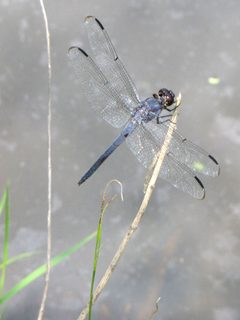
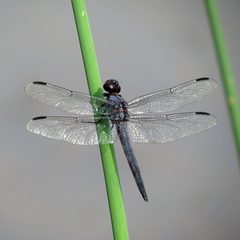
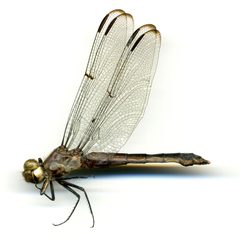
Libellula incesta, commonly known as the slaty skimmer, is a in the Libellulidae native to eastern North America. measure approximately 5.28 cm in length. The species exhibits pronounced in coloration: mature males are dark blue with black , while females and juveniles display brown with a darker stripe. Larvae are specialized inhabitants of lake benthos, and adults are active from June through August.
Pronunciation
How to pronounce Libellula incesta: /lɪˈbɛljʊlə ɪnˈsɛstɑ/
These audio files are automatically generated. While they are not always 100% accurate, they are a good starting point.
Identification
Mature males are readily identified by their dark blue bodies and black , distinguishing them from other Libellula in the region. Females and juveniles may be confused with other brown skimmers but can be recognized by the combination of brown with a distinct darker stripe. The slaty skimmer is one of several blue Libellula species in eastern North America, requiring careful attention to color intensity and pattern for definitive identification.
Images
Appearance
are 5.28 cm (2.08 in) long. Mature males are dark blue with black . Females and juveniles have brown with a darker stripe down their backs.
Habitat
Larvae are found in the benthos of permanent lakes. habitat requirements are not explicitly documented in available sources.
Distribution
Native to eastern United States and southern Ontario, Quebec, and New Brunswick in Canada.
Seasonality
fly from June to August.
Life Cycle
Larvae are aquatic and inhabit the benthos of permanent lakes. Specific details regarding deposition, larval development duration, or patterns are not documented in available sources.
Ecological Role
As a member of the Odonata, larvae function as aquatic in lake benthic . are aerial predators of other insects.
Similar Taxa
- Other Libellula speciesSeveral eastern North American Libellula , such as Libellula cyanea (spangled skimmer), have blue males that require careful comparison of color shade, pattern details, and body proportions for accurate identification.
More Details
Larval habitat specialization
The is noted for having larvae that are specifically adapted to the benthos of permanent lakes, which may limit its distribution to lacustrine environments.
Sources and further reading
- BugGuide
- Wikipedia
- GBIF taxonomy match
- iNaturalist taxon
- NCBI Taxonomy
- Catalogue of Life
- Just Buggin' Ya | Bug Squad
- Dragonfly Enthusiasts, Unite! Open House Set Nov. 6 at Bohart Museum | Bug Squad
- Know Your Dragonflies! | Bug Squad
- Bohart Museum Open House: Dragonflies Rule! | Bug Squad
- The Wonder of Dragonflies | Bug Squad
- Take a Bug Break--and Bring Along This Book | Bug Squad