
Williamsonia lintneri
(Hagen, 1878)
Ringed Boghaunter
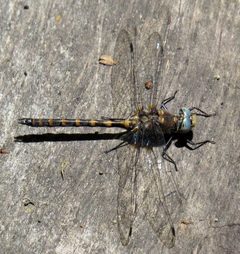
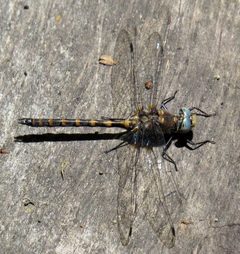
Williamsonia lintneri, commonly known as the ringed boghaunter, is a small in the emerald Corduliidae. It inhabits acid bogs in the northeastern United States and southeastern Canada, with a restricted range spanning Wisconsin, Michigan, New England, New York, New Jersey, and Ontario. are active early in the season, primarily during May and June. The is distinguished by distinctive yellow rings on the and gray-black coloration.
Pronunciation
How to pronounce Williamsonia lintneri: /ˌwɪliəmˈsoʊniə ˈlɪntnɛraɪ/
These audio files are automatically generated. While they are not always 100% accurate, they are a good starting point.
Identification
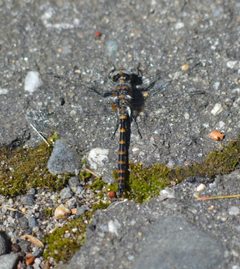
Distinguished from the related ebony boghaunter (Williamsonia fletcheri) by the prominent yellow rings on the . Perches flat on ground or tree trunks, unlike other emerald dragonflies which typically perch on vegetation.
Images
Appearance
Small emerald with gray-black overall coloration. are gray. has prominent yellow rings on each segment. Wings are clear with yellow at the base. Female has thicker abdomen than male.
Habitat
Acid wooded bogs; larvae occur in pools within these bogs. rarely seen at breeding sites.
Distribution
Restricted range in northeastern North America: Wisconsin, Michigan, New England (including Rhode Island), New York, New Jersey, and Ontario (discovered 2016). Previously considered to the United States.
Seasonality
active primarily in May and June; early-flying within its range.
Life Cycle
Larvae develop in pools within acid wooded bogs. emerge in spring. Specific details on larval duration, timing, and developmental stages not documented in available sources.
Behavior
Perches flat on ground or tree trunks, a that differs from other emerald dragonflies which typically perch on vegetation. rarely observed breeding despite presence of larvae in bog pools.
Human Relevance
Subject of analysis studies due to rarity and restricted range. Conservation concern due to limited distribution and specialized bog habitat requirements.
Similar Taxa
- Williamsonia fletcheriEbony boghaunter lacks prominent yellow rings on ; otherwise similar in size and preference