
Aleuropteryginae
dustywing lacewings
Genus Guides
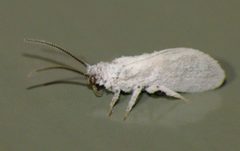
2Aleuropteryginae is a of dustywing lacewings within the Coniopterygidae. Members are minute neuropterans, often measuring less than 5 mm, with bodies and wings covered in a powdery, waxy secretion that gives them their . The subfamily contains both extant and extinct , with fossil known from amber deposits. Extant are found across multiple continents and are associated with diverse including forests and anthropogenic environments.
Pronunciation
How to pronounce Aleuropteryginae: /æl.jʊəˌrɒp.təˈrɪdʒ.ɪ.naɪ/
These audio files are automatically generated. While they are not always 100% accurate, they are a good starting point.
Identification
Distinguished from other Coniopterygidae ( Coniopteryginae) by wing venation patterns and genitalia structure; specifically, Aleuropteryginae typically have fewer crossveins in the forewing and distinct male paramere . The dusty, waxy coating is shared with other dustywings and not diagnostic alone. Identification to requires microscopic examination of wing venation and genital characters.
Images
Appearance
Extremely small lacewings, usually 2–5 mm in length. Body and wings densely covered with white or grayish waxy filaments, producing a dusty or mealy appearance. Wings are relatively broad with reduced venation compared to other neuropterans. are long and . Some exhibit reduced wing size or brachyptery.
Habitat
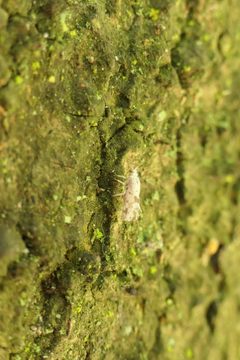
Found in diverse environments including deciduous and coniferous forests, scrublands, and urban areas. Many occupy the lower , leaf litter, or bark surfaces. Some (e.g., Conwentzia) are frequently recorded from buildings and indoor spaces.
Distribution
distribution with records from Europe, Asia, Africa, North America, South America, and Australia. Individual show varying ranges; for example, Conwentzia and Semidalis have broad distributions, while others are more restricted.
Seasonality
Activity patterns vary by and latitude. Many temperate species show in spring and summer, with some continuing into autumn. In suitable climates, multiple may occur annually. Indoor can be active year-round.
Diet
Predatory on small arthropods, particularly mites, scale insects, and other minute prey found on vegetation or bark. Specific prey records are sparse for most .
Life Cycle
Complete with , larval, pupal, and stages. Larvae are elongate, mobile, and also predatory. occurs in a silken cocoon. Developmental duration varies with temperature and ; some species appear to have multiple per year in favorable conditions.
Behavior
are generally slow-moving and cryptic, relying on their powdery coating for camouflage. Some are attracted to light. When disturbed, they may feign death or drop from substrates. Larvae are active hunters.
Ecological Role
of small arthropods in microhabitats; likely contribute to regulation of mite and insect in forest and on vegetation.
Human Relevance
Generally harmless; occasionally found indoors where they may be mistaken for pests due to their small size and dusty appearance. Some (e.g., in Conwentzia) have been noted in buildings but do not cause damage. Potential value as agents of mites and small pests remains underexplored.
Similar Taxa
- ConiopteryginaeOther of Coniopterygidae; distinguished by wing venation with more crossveins and different genitalia structure. Both subfamilies share the dusty appearance.
More Details
Fossil record
The includes several extinct known from Cretaceous and Cenozoic amber deposits (Achlyoconis, Alboconis, Archiconiocompsa, Geroconiocompsa, Libanoconis), indicating a long evolutionary history. These fossils help establish minimum ages for lineage diversification within dustywing lacewings.