
Boreus brumalis
Fitch, 1847
mid-winter boreus, snow scorpionfly
Boreus brumalis, commonly known as the mid-winter boreus or snow scorpionfly, is a small, wingless insect in the Boreidae. Despite its , it is neither a nor a fly, but belongs to the order Mecoptera. are active during winter months and can be observed running across snow and ice. This is found in North America, including the northeastern United States. Males possess distinctive upward-curving genitalia that resemble a scorpion's stinger, though the insect cannot sting. Snow scorpionflies are believed to be ancient relatives of fleas.
Pronunciation
How to pronounce Boreus brumalis: //ˈbɔːriəs bruːˈmɑːlɪs//
These audio files are automatically generated. While they are not always 100% accurate, they are a good starting point.
Identification
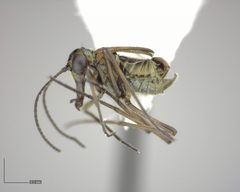
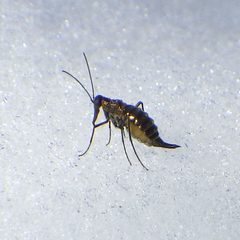
Boreus brumalis is a tiny insect, typically 5 mm or less in length. lack functional wings and cannot fly—a key distinction from other Mecoptera. Males possess large, upward-curving genitalia that superficially resemble a 's stinger; females lack this structure. The body is slender with an elongated rostrum (snout). Coloration is generally dark. The wingless condition distinguishes Boreidae from winged scorpionflies in such as Panorpidae.
Images
Habitat
Found in moist, lowland forests near streams. occur on snow, ice, and on mosses and liverworts, which serve as food sources.
Distribution
North America; recorded from the northeastern United States including Vermont and Maryland.
Seasonality
Active during winter months, from December through February. can be observed on cold, sunny days even when temperatures are below freezing.
Diet
and larvae feed on mosses and liverworts.
Behavior
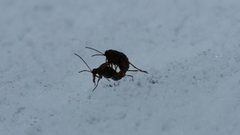
disperse between breeding areas by running across open snow. Males engage in a distinctive mating ritual: they grasp the female and place her on their back for a ride, possibly to limit access by rival males. Adults are capable of hopping.
Human Relevance
Of minimal direct human relevance. Occasionally encountered by naturalists and entomologists during winter field work. Requires magnification to observe due to small size.
Similar Taxa
- Panorpa spp. (common scorpionflies)Winged relatives in the same order Mecoptera; Boreus brumalis is wingless and active in winter, while Panorpa have functional wings and are active in warmer months.
- Other Boreus speciesClosely related snow scorpionflies with similar appearance and habits; specific identification requires examination of genitalia.
Sources and further reading
- BugGuide
- Wikipedia
- GBIF taxonomy match
- iNaturalist taxon
- NCBI Taxonomy
- Catalogue of Life
- Dashing through the snow: Snow scorpionflies, Boreus sp. — Bug of the Week
- Dashing through the snow: Snow scorpionflies, Boreus sp. — Bug of the Week
- Dashing through the snow, Snow scorpionflies, Boreus sp. — Bug of the Week
- Archive — Bug of the Week
- Did you ever see a scorpion fly? Panorpa sp. — Bug of the Week
- Dashing through the snow: Snow scorpionflies, Boreus sp. — Bug of the Week
- The Genital Anatomy and Mating Behavior of Boreus brumalis Fitch (Mecoptera)