
Lithacodes fasciola
(Herrich-Schäffer, 1854)
yellow-shouldered slug, ochre-winged hag moth
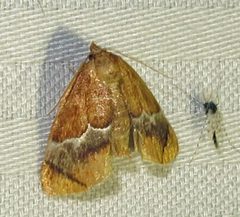
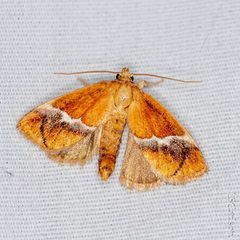
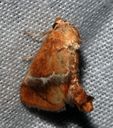
Lithacodes fasciola is a small slug in the Limacodidae, commonly known as the yellow-shouldered slug or ochre-winged hag moth. The exhibits distinctive larval and , with caterpillars showing bright yellow-green coloration with striping and adults displaying characteristic wing patterns. It has a broad distribution across eastern North America with variable voltinism depending on latitude. The larvae feed on a wide range of deciduous trees and shrubs.
Pronunciation
How to pronounce Lithacodes fasciola: /ˌlɪθəˈkoʊdiːz ˌfæsiˈoʊlə/
These audio files are automatically generated. While they are not always 100% accurate, they are a good starting point.
Identification
distinguished from similar brown limacodid by the combination of white forewing stripe with black borders, black spots, and black crescent marking. Larvae identifiable by the flattened, slug-like body form (characteristic of ), bright yellow-green coloration with striping, and small craters. The squared of the larva differs from more tapered forms in related .
Images
Habitat
Associated with deciduous forests and wooded areas supporting plants. Occupies containing apple, beech, birch, blueberry, cherry, chestnut, hickory, honey locust, hornbeam, linden, maple, oak, and willow.
Distribution
Eastern North America. Documented from Vermont and other United States locations. Range extends across much of eastern North America with latitudinal variation in number.
Seasonality
period and larval presence vary by latitude. In northern portions of range, one annually with mature caterpillars present May through November. In southern United States, two or more generations occur annually.
Diet
Larvae feed on foliage of diverse deciduous trees and shrubs: apple (Malus), beech (Fagus), birch (Betula), blueberry (Vaccinium), cherry (Prunus), chestnut (Castanea), hickory (Carya), honey locust (Gleditsia), hornbeam (Carpinus), linden (Tilia), maple (Acer), oak (Quercus), and willow (Salix).
Host Associations
- Malus - larval food plantapple
- Fagus - larval food plantbeech
- Betula - larval food plantbirch
- Vaccinium - larval food plantblueberry
- Prunus - larval food plantcherry
- Castanea - larval food plantchestnut
- Carya - larval food planthickory
- Gleditsia - larval food planthoney locust
- Carpinus - larval food planthornbeam
- Tilia - larval food plantlinden
- Acer - larval food plantmaple
- Quercus - larval food plantoak
- Salix - larval food plantwillow
Life Cycle
Holometabolous with , larva, pupa, and stages. Voltinism varies geographically: in northern range, or multivoltine in southern United States. Larvae present May through November depending on location and . occurs in a cup-shaped cocoon with circular escape hatch. High proportion of larvae parasitized by flies; presence indicated by black spot formed by breathing siphon visible before .
Behavior
Larvae move with characteristic slug-like locomotion due to reduced legs and suction-cup . Larvae are exposed feeders on leaf surfaces. High susceptibility to flies has been documented.
Ecological Role
Herbivore in deciduous forest . Larvae function as leaf consumers on diverse woody plants. Serves as for flies, contributing to complexity. Role in nutrient cycling through herbivory and deposition of .
Human Relevance
Occasional defoliator of fruit trees (apple, cherry, blueberry) and ornamental trees. Not considered a major pest. Larval contact may cause skin irritation typical of limacodid caterpillars, though specific reports for this are not documented.
Similar Taxa
- Other Lithacodes speciesSimilar size and general brown coloration; distinguished by specific wing pattern elements (white stripe with black borders, black crescent)
- Other Limacodidae larvaeShared slug-like larval form; distinguished by specific color pattern of bright yellow-green with yellow and green stripes and small craters
More Details
Parasitoid pressure
A high proportion of larvae are parasitized by flies. The presence of can be detected before fly by the appearance of a black spot formed by the breathing siphon of the developing parasitoid.
Voltinism variation
number varies clinally with latitude, from single generation in the north to two or more in the southern United States. This pattern reflects to seasonal length and temperature regimes.
Sources and further reading
- BugGuide
- Wikipedia
- GBIF taxonomy match
- NCBI Taxonomy
- Catalogue of Life
- Guest blog post: Snakes disembowel and feed on the organs of living toads in a first for science | Blog
- Guest blog post: Unique feeding behaviour of Asian kukri snakes gutting frogs and toads | Blog
- Asian snakes | Blog
- Kukri Snake | Blog