
Isa textula
(Herrich-Schäffer, 1854)
crowned slug moth, skiff moth
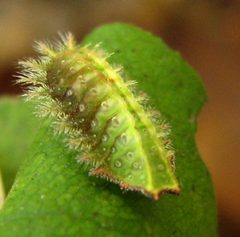
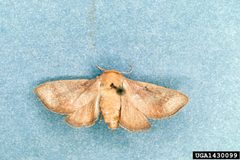
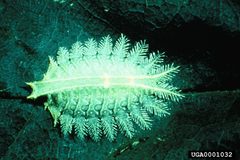
Isa textula is a in the Limacodidae, commonly known as the crowned slug moth or skiff moth. The is notable for its distinctive caterpillar, which has a flattened, slug-like body with radiating lobes bearing stinging spines. are less conspicuous than the larvae. The species occurs across eastern North America and has been documented in forested from the ground to tree .
Pronunciation
How to pronounce Isa textula: /ˈaɪsə tɛksˈtuːlə/
These audio files are automatically generated. While they are not always 100% accurate, they are a good starting point.
Identification
The caterpillar is distinguished from other Limacodidae by its pale green coloration and distinctive lacy, radiating marginal lobes with stinging spines. The overall flattened, sea slug-like appearance is characteristic. are not described in detail in available sources. The should be distinguished from Prolimacodes badia, which shares the "skiff moth" but belongs to a different .
Images
Habitat
Found in forested areas including mesic riparian forest and dry-mesic woodlands. Caterpillars occur on trees; mature larvae descend to the ground to spin cocoons in protected locations. One observation notes a caterpillar found in leaf litter, likely seeking site.
Distribution
Eastern North America from Minnesota, southern Ontario, and Massachusetts south to Florida, Texas, and Mississippi. GBIF records confirm occurrence in Vermont and other US states.
Seasonality
Mature caterpillars have been observed in October, suggesting late-season activity before as pupae. One record notes a caterpillar found in February in southern Arizona, but this appears to be an anomalous indoor occurrence of a different (context discusses Litoprosopus coachella, not Isa textula).
Diet
Larvae feed on leaves of various trees including oak (Quercus), cherry (Prunus), maple (Acer), basswood (Tilia), elm (Ulmus), and beech (Fagus).
Host Associations
- Quercus - larval food plantoak
- Prunus - larval food plantcherry
- Acer - larval food plantmaple
- Tilia - larval food plantbasswood
- Ulmus - larval food plantelm
- Fagus - larval food plantbeech
Life Cycle
Complete . Larvae feed on tree leaves. Mature caterpillars descend to ground to spin silken cocoons in protected locations and overwinter as pupae. emerge in subsequent season.
Behavior
Mature caterpillars exhibit downward crawling from trees to locate sites on or near the ground. Caterpillars possess stinging spines as a defensive . No other behaviors described in sources.
Ecological Role
Herbivore in forest ; larvae consume foliage of various deciduous trees. Serves as prey for unspecified . Stinging spines suggest aposematic or defensive function against .
Human Relevance
Caterpillar stinging spines may cause irritation upon contact, though not explicitly documented in sources. Of interest to entomologists and naturalists for distinctive larval . Subject of macrophotography due to unusual appearance.
Similar Taxa
- Prolimacodes badiaShares the "skiff moth" but is a distinct in the same ; differ in appearance and larval not described as overlapping
- Other Limacodidae members share slug-like larval form, but Isa textula is distinguished by specific arrangement of radiating lobes with stinging spines and pale green coloration
More Details
Nomenclature note
The "skiff moth" is shared with Prolimacodes badia, potentially causing confusion. Isa textula is also called "crowned slug ," which appears to be the more distinctive common name.
Photography note
The has been photographed in Shenandoah National Park, Virginia, where a caterpillar was found well above height in a tree, requiring use of a step stool for access.