
Adoneta bicaudata
Dyar, 1904
Long-horned Slug Moth
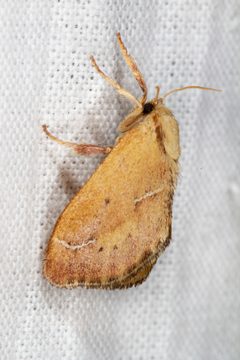
Adoneta bicaudata, commonly known as the long-horned slug , is a of moth in the Limacodidae. It is characterized by its distinctive larval form, which bears elongated projections. The species was described by Dyar in 1904 and is assigned MONA/Hodges number 4684. Like other members of its family, the caterpillar has a reduced, slug-like body form with suckers instead of .
Pronunciation
How to pronounce Adoneta bicaudata: /ˌædəˈniːtə ˌbaɪkaʊˈdeɪtə/
These audio files are automatically generated. While they are not always 100% accurate, they are a good starting point.
Identification
The larva can be distinguished from other Limacodidae by the presence of two elongated tail-like projections at the end. These horns are longer than those found in related such as Adoneta spinuloides. may require dissection or genital examination for definitive identification.
Images
Appearance
are small with relatively broad wings. The larva is a slug caterpillar with a flattened, reduced body and prominent paired projections (the "long horns" referenced in the ). The caterpillar lacks the typical of most moth larvae, instead possessing suckers that allow it to glide along leaf surfaces.
Habitat
Associated with deciduous forests and woodland edges where plants occur.
Distribution
Eastern North America. Specific range details beyond this general region are not well documented in available sources.
Seasonality
are active during summer months; exact period varies by latitude.
Life Cycle
Complete with , larva, pupa, and stages. Larvae are slug caterpillars that pupate in a cocoon.
Behavior
Larvae move with a characteristic gliding motion using suckers rather than crawling. The projections may serve a defensive function.
Ecological Role
Larval herbivore; specific ecological impacts not documented.
Human Relevance
Larvae possess urticating (stinging) spines characteristic of Limacodidae and can cause skin irritation upon contact. The is of minor medical significance due to this defensive capability.
Similar Taxa
- Adoneta spinuloidesAlso in Adoneta, but has shorter projections and different spination pattern on larvae.
- Other LimacodidaeMany slug caterpillar moths share the general larval body form, but Adoneta bicaudata is distinguished by the specific length and arrangement of its caudal horns.
More Details
Taxonomic authority
First described by Harrison Gray Dyar in 1904.
Hodges number
Assigned MONA ( of North America) number 4684 in the North American moth numbering system.