
Zelleria haimbachi
Busck, 1915
pine needle sheathminer
Zelleria haimbachi, commonly known as the pine needle sheathminer, is a small in the Yponomeutidae. The is native to western North America, where it is associated with pine forests. Larvae are specialized miners that feed within the of pine needles, an unusual feeding strategy among conifer-feeding Lepidoptera. The species has been recorded as a localized pest, with documented events in British Columbia spanning several decades.
Pronunciation
How to pronounce Zelleria haimbachi: /zɛˈlɛr.i.a haɪmˈbɑː.ki/
These audio files are automatically generated. While they are not always 100% accurate, they are a good starting point.
Identification
The can be identified by its association with pine needle mining damage and its small size. Definitive identification likely requires examination of genitalia or molecular methods, as is common for small yponomeutid . The mining habit within needle sheaths, rather than on needle surfaces or in cones, distinguishes the larvae from most other pine-feeding Lepidoptera.
Images
Appearance
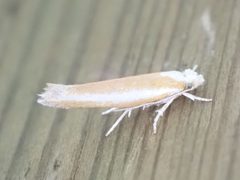
are small with a wingspan of approximately 13 mm. Detailed external is not well documented in available sources.
Habitat
Pine forests, particularly those dominated by Pinus . Larval is specifically within the of pine needles.
Distribution
North America: British Columbia (south of 52° north latitude), east to Quebec, and south to California.
Diet
Larvae feed on pine needles by mining within the needle . Documented include Pinus banksiana, Pinus contorta, Pinus ponderosa, Pinus resinosa, Pinus sylvestris, Pseudotsuga menziesii subsp. glauca, and Picea glauca.
Host Associations
- Pinus banksiana - larval primary
- Pinus contorta - larval primary
- Pinus ponderosa - larval primary
- Pinus resinosa - larval less frequent
- Pinus sylvestris - larval less frequent
- Pseudotsuga menziesii subsp. glauca - larval less frequent
- Picea glauca - larval less frequent
Behavior
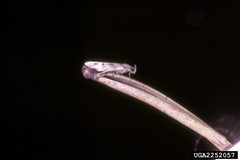
Larvae are needle- miners, feeding inside pine needle sheaths rather than externally on foliage. This endophytic feeding habit is the ' defining behavioral trait.
Ecological Role
Herbivore; functions as a pest in pine forests. Mining activity damages pine needles and can cause localized .
Human Relevance
Considered a pest of pine trees. Documented in British Columbia include: Penticton (1951), Spences Bridge (1958), Louis Creek and Scotch Creek (1962), Clearwater-Vavenby (1979-1980), and Clearwater-Shuswap (1985-1992).
Similar Taxa
- Other Zelleria speciesSame ; identification requires detailed examination
- Other needle-mining LepidopteraSimilar damage ; -mining habit is distinctive for Z. haimbachi
More Details
Taxonomic note
The has been variously placed in Yponomeutidae, Hyponomeutidae, or Plutellidae depending on the classification system used. The spelling 'Hyponomeutidae' in some older literature refers to the same group.