
Bedellia
Stainton, 1849
morning-glory leaf miner
Species Guides
1- Bedellia somnulentella(sweet potato leaf miner)
Bedellia is the sole of the Bedelliidae, a group of small, narrow-winged . Most authorities recognize Bedelliidae as a distinct family, though some classifications treat it as the Bedelliinae within Lyonetiidae. The genus contains several , with Bedellia somnulentella (the sweet potato leafminer) being the most economically significant. This species is an pest of sweet potato (Ipomoea batatas) and related Convolvulaceae, with larvae feeding as leafminers in the leaf mesophyll.


Pronunciation
How to pronounce Bedellia: /bɛˈdɛl.i.ə/
These audio files are automatically generated. While they are not always 100% accurate, they are a good starting point.
Identification
Identification to level requires examination of genitalia and wing venation patterns typical of Bedelliidae. Within the , Bedellia is the only recognized genus by most authorities. -level identification, particularly of B. somnulentella, is possible from the third larval instar and in pupal and adult stages; earlier instars require rearing for confirmation.
Images
Appearance
Small with narrow, elongate wings. are minute to small in size, consistent with the microlepidopteran grade. Specific morphological details for the as a whole are not well documented in the provided sources.
Habitat
Agricultural fields, particularly sweet potato crops; also found in natural and semi-natural where plants of the Convolvulaceae occur, including disturbed areas, field edges, and regions with wild Ipomoea .
Distribution
distribution reported for B. somnulentella. Documented occurrences include: Brazil (Minas Gerais state, Atlantic Forest biome), United States (Florida, North Florida specifically), and records from Denmark, Norway, and Sweden (GBIF). Distribution is expanding in tropical and subtropical regions where sweet potato occurs.
Host Associations
- Ipomoea batatas - primary Sweet potato; main commercial sustaining economically significant
- Ipomoea hederifolia - alternative Wild morning glory; supports higher survival and development compared to I. indica and I. purpurea
- Ipomoea indica - alternative Wild morning glory; lower survival and development rates compared to I. batatas and I. hederifolia
- Ipomoea purpurea - alternative Wild morning glory; lower survival and development rates compared to I. batatas and I. hederifolia
- Ipomoea alba - alternative New record from Brazil
- Ipomoea cairica - alternative New record from Brazil
- Distimake dissectus var. edentatus - alternative New record from Atlantic Forest biome, Brazil
- Calystegia sepium - alternative Hedge bindweed; supports development and
Life Cycle
Complete with , larva, , pupa, and stages. For B. somnulentella on Ipomoea batatas: total developmental period approximately 32.5 days with viability of 75% (egg), 84% (larva), 100% (prepupa), and 84% (pupa). Number of larval instars determined by cephalic capsule width measurements using and Akaike statistical model. occurs in silk cocoons on leaves or in soil.
Behavior
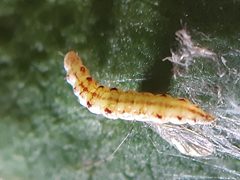
Larvae are leafminers, feeding between the upper and lower of leaves on the mesophyll tissue. This feeding pattern creates characteristic mines that reduce photosynthetic capacity, causing leaves to become brown and wrinkled. Larval coloration varies depending on plant . are narrow-winged and likely weak fliers typical of microlepidoptera.
Ecological Role
Agricultural pest causing direct damage to Convolvulaceae crops, particularly sweet potato. Wild Ipomoea serve as , sustaining during off-season periods when cultivated hosts are absent. This reservoir function facilitates pest and survival across different regions. Natural enemies include (Conura sp., Chalcididae) and (Agelaia vicina, Vespidae), which may contribute to .
Human Relevance
Significant economic pest of sweet potato in tropical and subtropical regions. Damage reduces photosynthetic area and yield. status in Brazil and expanding distribution in the United States. Early detection and monitoring are emphasized for to minimize economic losses and reduce use. Potential for using identified and .
Similar Taxa
- LyonetiidaeBedelliidae was historically included within Lyonetiidae as Bedelliinae; some authors still maintain this classification. Lyonetiidae contains similar small, narrow-winged leafmining requiring genitalia examination for distinction.
- Other leafmining Lepidoptera (Gracillariidae, Phyllocnistidae)Similar leafmining habits but differ in wing shape, venation, and larval ; Bedellia has distinctive narrow wings and specific associations with Convolvulaceae.
More Details
Taxonomic Status
The -level status of Bedelliidae remains debated. Most modern authorities recognize Bedelliidae as a distinct family within Yponomeutoidea, while some classifications retain it as Bedelliinae within Lyonetiidae. This taxonomic uncertainty reflects ongoing revisions in microlepidopteran .
Invasion Biology
B. somnulentella exhibits classic pest characteristics: distribution, broad range within Convolvulaceae, high reproductive potential, and association with cultivated crops. Its establishment in Brazil and detection in Florida represent range expansion facilitated by agricultural trade and of Ipomoea batatas.
Sources and further reading
- BugGuide
- Wikipedia
- GBIF taxonomy match
- iNaturalist taxon
- NCBI Taxonomy
- Catalogue of Life
- Bedellia somnulentella (Lepidoptera: Bedelliidae) in sweet potato in North Florida
- Bedellia somnulentella (Lepidoptera: Bedelliidae): new hosts of the genus Ipomoea (Convolvulaceae) in Brazil
- The Development and Reproduction of Bedellia somnulentella1 on Hedge Bindweed and Swee Potato
- Distribution expansion and new occurrence records of Bedellia somnulentella (Lepidoptera: Bedelliidae) in Minas Gerais state, Brazil
- The invasive Bedellia somnulentella (Lepidoptera: Bedelliidae): new record of host plant, predator and biome in Brazil
- Biology and Control of the Morning-Glory Leaf Miner, Bedellia somnulentella, on Sweet Potatoes1
- Bedellia somnulentella (Lepidoptera: Bedelliidae): record of a new host and predator in Atlantic Forest biome in Minas Gerais state, Brazil
- Geographic distribution of the Ipomoea batatas (Convolvulaceae) pest, Bedellia somnulentella (Zeller) (Lepidoptera: Bedelliidae), in Minas Gerais state, Brazil
- Life History of Bedellia somnulentella (Lepidoptera: Bedelliidae) Feeding on Ipomoea batatas (Solanales: Convolvulaceae) Leaves and Survey of Parasitoids in Brazil
- Biology of Bedellia somnulentella (Lepidoptera: Bedelliidae) Associated with Wild Ipomoea spp. (Convolvulaceae) as Host Plants
- Changes in Chlorophyll a Fluorescence in Ipomoea batatas (Convolvulaceae) Genotypes Under Attack by Bedellia somnulentella (Lepidoptera: Bedelliidae).