
Argyresthia pruniella
(Clerck, 1759)
cherry fruit moth, cherry blossom tineid
Argyresthia pruniella is a small in the Argyresthiidae, commonly known as the cherry fruit moth or cherry blossom tineid. It is recognized by its distinctive reddish-brown forewings with white markings and narrow, fringed hindwings. The is considered an agricultural pest due to larval feeding in the shoots of fruit trees. It occurs across Europe, Asia Minor, and North America.
Pronunciation
How to pronounce Argyresthia pruniella: /ɑːrˌdʒaɪˈrɛsθia pruːniˈɛlə/
These audio files are automatically generated. While they are not always 100% accurate, they are a good starting point.
Identification
Distinguished from similar Argyresthia by the combination of reddish-brown forewing ground color with contrasting white stripe and dark transverse band. The row of white spots along the forewing margin and white-banded are additional diagnostic characters. Larval association with Prunus and other Rosaceae aids identification. Dissection of genitalia may be required for definitive separation from closely related species.
Images
Appearance
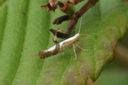
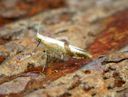
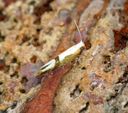
have a wingspan of 10–13 mm. Forewings are reddish-brown with a white stripe, a dark transverse brown stripe across the middle, and a row of white spots along the lower edge. Hindwings are brownish, very narrow, with long fringes. are white with brown bands. Caterpillars are pale green with a brown .
Habitat
Associated with orchards and areas where plants (Rosaceae fruit trees and Corylus) occur. Larvae develop within shoots of host trees.
Distribution
Europe (widespread), Asia Minor, and North America. Present in Belgium with records from Brussels-Capital Region, Flemish Region, Walloon Region, and Antwerp province.
Seasonality
period from early July to late August.
Diet
Larvae are oligophagous, feeding internally in shoots of plants.
Host Associations
- Malus - larval apple
- Prunus - larval apricot, cherry, peach, plum
- Pyrus - larval pear
- Corylus - larval hazel
Life Cycle
Larva lives in shoots of plants. Specific details of placement, site, and stage not documented in available sources.
Behavior
are attracted to light.
Ecological Role
As a shoot-boring larva, it may act as a phytophagous pest in natural and cultivated with trees. Specific functions not documented.
Human Relevance
Considered a pest of cultivated fruit trees (apple, cherry, peach, plum, pear) due to larval damage to shoots.
Similar Taxa
- Other Argyresthia speciesMany Argyresthia share small size and metallic or striped wing patterns; genitalia dissection often required for definitive identification
- Argyresthia fundellaSimilar size and pattern; requires examination of genitalia or association for separation