
Psyche
Schrank, 1801
bagworm moths
Species Guides
1- Psyche casta(Bagworm Moth)
Psyche is a of bagworm moths in the Psychidae, established by Schrank in 1801. The genus name derives from the Greek word for 'soul' or 'mind.' Larvae construct portable cases from silk and environmental materials such as plant debris, sand, or soil particles. are typically small to medium-sized with reduced mouthparts; females of many are wingless.
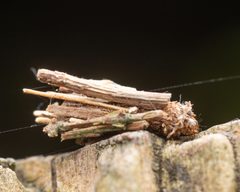
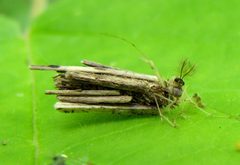
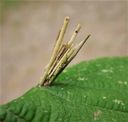
Pronunciation
How to pronounce Psyche: /ˈsaɪ.kiː/
These audio files are automatically generated. While they are not always 100% accurate, they are a good starting point.
Identification
Distinguished from other Psychidae by case and larval habits. Wingless females and case-bearing larvae are diagnostic for the . Specific identification requires examination of genitalia in males and case structure in larvae. The genus name Psyche should not be confused with the unrelated Leptosia nina, which shares the 'Psyche' in some regions.
Images
Habitat
Larvae occur in diverse terrestrial including woodlands, heathlands, grasslands, and coastal dunes. Specific habitat associations vary by . Cases are typically attached to vegetation, fences, walls, or other substrates during feeding and .
Distribution
Palearctic distribution with recorded across Europe and Asia. Some species have broader ranges; precise distribution varies considerably among the constituent species of the .
Seasonality
periods vary by and latitude, generally occurring in late spring through summer in temperate regions. Larvae are present year-round, with typically occurring in the larval stage within the protective case.
Diet
Larvae feed on a variety of plant materials including lichens, , mosses, and herbaceous vegetation. Some are feeders; others show preferences for particular plants.
Life Cycle
Complete with four stages: , larva, pupa, . Larval stage prolonged, lasting months to over a year depending on and climate. Larvae construct and enlarge portable cases throughout development, pupating within the case. Wingless females often remain near site, releasing to attract flying males.
Behavior
Larvae carry their cases throughout feeding and locomotion, extending the and to feed while the remains protected within the case. Cases are permanently attached to substrate prior to . Males actively seek females by following trails.
Ecological Role
Herbivores contributing to nutrient cycling through consumption of plant detritus, lichens, and . Larval cases provide microhabitat structure. Serve as prey for various and vertebrate .
Human Relevance
Occasional minor pests in gardens and orchards when larval are high. Some feed on lichens and mosses on buildings and monuments, causing aesthetic damage. Scientific interest in case construction and .
Similar Taxa
- Other Psychidae generaShare case-bearing larval habit and wingless females; distinguished by case , larval preferences, and genitalia structure
- Leptosia nina (butterfly)Shares 'Psyche' but belongs to entirely different order (Lepidoptera: Pieridae); are fully winged butterflies with clubbed , not
More Details
Etymology
The name Psyche derives from Ancient Greek ψυχή (psychē), meaning 'soul,' 'mind,' or 'breath of life.' The name was later adopted into English as the root of 'psychology' and 'psychedelic.'
Research history
The has been subject to taxonomic revision; some former Psyche have been transferred to other genera. The Psychidae remains actively studied for its remarkable larval and .
Sources and further reading
- BugGuide
- Wikipedia
- iNaturalist taxon
- NCBI Taxonomy
- Catalogue of Life
- Psychedelic rock gecko among dozens of species in need of further conservation protection in Vietnam
- Rattlesnakes may be present! | Beetles In The Bush
- The “silky-bellied humpbacked” ant | Beetles In The Bush
- Bug Eric: Spider Sunday: Striped Lynx Spider
- Bug Eric: Spider Sunday: Marbled Cellar Spider
- Bug Eric: A Nursery Web Spider, Pisaurina dubia
- The renaissance of research on psychedelics in child and adolescent psychopharmacology.