
Eulogia ochrifrontella
Zeller, 1875
Broad-banded Eulogia Moth
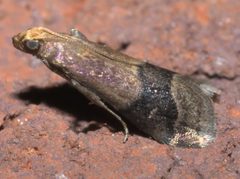
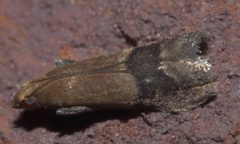
Eulogia ochrifrontella is a small snout moth and the sole member of its . It is commonly known as the broad-banded eulogia moth. The occurs across much of North America and has been documented from Canada through the eastern and central United States. It is associated with hardwood trees including pecan, oak, and apple.
Pronunciation
How to pronounce Eulogia ochrifrontella: /juːˈloʊdʒiə ɒkrɪfrɒnˈtɛlə/
These audio files are automatically generated. While they are not always 100% accurate, they are a good starting point.
Identification
The combination of small size (11–15 mm wingspan), broad banded forewing pattern, and ochre-colored frontal region distinguishes this from similar small pyralid moths. The Eulogia is , so identification to genus level confirms the species. Within Phycitinae, look for the characteristic banded wing pattern and pale coloration.
Images
Appearance
Small with wingspan of 11–15 mm. The exhibits the characteristic snout moth with prominent labial palps. The forewings display a broad banded pattern referenced in the , with ochre or yellowish coloration on the frontal region of the .
Habitat
Associated with deciduous hardwood forests and orchards where plants occur. Larval includes foliage and nuts/fruits of Carya, Quercus, and Malus .
Distribution
North America: documented from British Columbia, Alberta, Saskatchewan, Manitoba, Ontario (Canada); and Maine, Massachusetts, New Jersey, Pennsylvania, Virginia, Florida, Tennessee, Illinois, Minnesota, Oklahoma, Washington, Vermont (United States).
Seasonality
active in June and July.
Diet
Larvae feed on Carya illinoinensis (pecan), Quercus (oaks), Malus species (apples), and possibly Amelanchier alnifolia (saskatoon serviceberry).
Host Associations
- Carya illinoinensis - larval food plantpecan
- Quercus - larval food plantoak
- Malus - larval food plantapple
- Amelanchier alnifolia - possible larval food plantrecorded as possible
Ecological Role
Larval herbivore on hardwood trees; contributes to nutrient cycling in deciduous forest . Potential minor pest in pecan and apple orchards.
Human Relevance
Minor economic significance as a potential pest of pecan and apple crops. Otherwise little direct interaction with humans.
Similar Taxa
- Other Phycitinae speciesSimilar small size and banded wing patterns; distinguished by ochre frontal region and specific wing banding pattern of E. ochrifrontella
- Other small PyralidaeGeneral morphological similarity; requires examination of coloration and forewing pattern for accurate identification