
Arta statalis
Grote, 1875
posturing arta moth
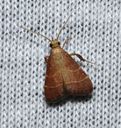
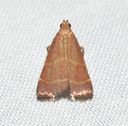
Arta statalis is a small snout moth in the Pyralidae, described by Augustus Radcliffe Grote in 1875. It serves as the type for the Arta. The species is notable for its distinctive resting posture, with hindwings tucked behind forewings and positioned flat behind the . It occurs across eastern North America in diverse including woodlands and residential areas.
Pronunciation
How to pronounce Arta statalis: /ˈɑːrtə stəˈteɪlɪs/
These audio files are automatically generated. While they are not always 100% accurate, they are a good starting point.
Identification
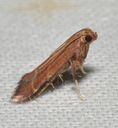
Distinguished from similar pyralid moths by its small size (~15 mm wingspan), the characteristic resting posture with hindwings concealed behind forewings, and the flat positioning of behind the and over the wings. The brown forewings with pale separating lines provide additional diagnostic characters. The Arta contains multiple ; A. statalis is the type species and can be identified by the combination of size, color pattern, and resting posture described.
Images
Habitat
Occurs in woodlands, residential areas, and lake shorelines. Shows adaptability to both natural and human-modified environments.
Distribution
Eastern North America: Delaware, Florida, Georgia, Illinois, Iowa, Massachusetts, New Jersey, New York, North Carolina, Oklahoma, Pennsylvania, South Carolina, Tennessee, Virginia, and Vermont.
Behavior
Rests with hindwings tucked behind forewings and positioned flat behind the and over the wings. This distinctive posture is the source of its 'posturing arta .'
Similar Taxa
- Other Arta speciesSame , distinguished by specific wing patterns, size, and the characteristic resting posture of A. statalis
- Other Chrysauginae mothsSimilar body form and size; distinguished by the specific color pattern and positioning of A. statalis
Sources and further reading
- BugGuide
- Wikipedia
- GBIF taxonomy match
- iNaturalist taxon
- NCBI Taxonomy
- Catalogue of Life
- Encyrtid Holdings | Entomology Research Museum
- Bug Eric: Remembering Moth Week 2025
- Three new species of ground snakes discovered under graveyards and churches in Ecuador
- Bug Eric: The Wasps and the Fly
- Entomological Vase Earns First Place in Art Show at 2022 Joint Annual Meeting