
Diasemiodes nigralis
(Fernald, 1892)
Black shawl moth
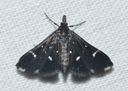
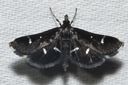
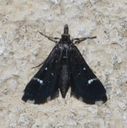
Diasemiodes nigralis is a small crambid found in the southeastern United States. are characterized by predominantly black wings with distinctive white markings. The exhibits year-round activity in Florida and seasonal activity farther north.
Pronunciation
How to pronounce Diasemiodes nigralis: /di.asɛ.miˈo.dɛs nɪˈɡra.lɪs/
These audio files are automatically generated. While they are not always 100% accurate, they are a good starting point.
Identification
Distinguished from similar black crambid by the specific configuration of white markings: the nearly straight (not curved) outer forewing stripe, paired spots on forewing fold and end, and the oblique hindwing stripe from the anal angle. The combination of small size (18 mm wingspan) and this exact white pattern separates it from and other black Crambidae in its range.
Images
Distribution
Southeastern United States, from Florida west to Texas. Stray individuals recorded north to Michigan and Maryland.
Seasonality
active May to October in most of range; year-round in Florida.
Similar Taxa
- Other Diasemiodes species share similar size and general wing pattern type, but differ in specific arrangement and shape of white markings; D. nigralis uniquely shows the straight outer stripe and oblique hindwing anal angle stripe combination.
- Other black Crambidae in southeastern USMany crambid have dark wings with pale markings; precise pattern details (stripe straightness, spot positions) required for separation.
More Details
Taxonomic history
Described by Charles H. Fernald in 1892. The specific epithet 'nigralis' refers to the black coloration of the wings.