
Hileithia aplicalis
(Guenée, 1854)
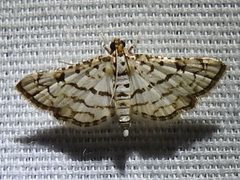
Hileithia aplicalis is a small crambid described by Guenée in 1854. It is known from the southeastern and southwestern United States, with records from Georgia, Florida, Texas, and Arizona. are active from February through August. The remains poorly documented, with limited biological information available.
Pronunciation
How to pronounce Hileithia aplicalis: /hɪˈlaɪθiə ˌæplɪˈkeɪlɪs/
These audio files are automatically generated. While they are not always 100% accurate, they are a good starting point.
Identification
The extremely small wingspan (about 11 mm) distinguishes Hileithia aplicalis from larger crambid . Definitive identification likely requires examination of genitalia or molecular methods, as external is insufficiently described in available literature. Records are restricted to the southern United States.
Images
Distribution
United States: Georgia, Florida, Texas, and Arizona.
Seasonality
recorded on wing from February to August.
Similar Taxa
- Other Hileithia speciesCongeneric may overlap in distribution and require dissection for reliable separation; external characters are poorly differentiated in this .
- Small Crambinae and other CrambidaeNumerous small crambid share similar size and general appearance; identification to and requires specialized examination.
More Details
Nomenclature
The specific epithet 'aplicalis' appears to be a Latin compound, though its etymology is not documented in available sources. The original description by Guenée (1854) provides the foundation for all subsequent records.
Documentation Status
With only 17 iNaturalist observations and minimal published biological data, this is among the more poorly known North American Crambidae. Most records appear to be incidental captures rather than targeted surveys.