
Lygropia plumbicostalis
(Grote, 1871)
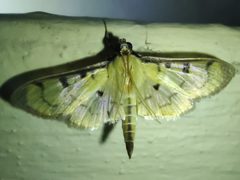
Lygropia plumbicostalis is a small crambid described by Grote in 1871. The has a wingspan of approximately 27 mm. It occurs in the southwestern and southeastern United States, with records from Arizona, Florida, and Texas. are active from May through September.
Pronunciation
How to pronounce Lygropia plumbicostalis: /laɪˈɡroʊpiə plʌmbikoʊˈstælɪs/
These audio files are automatically generated. While they are not always 100% accurate, they are a good starting point.
Identification
Distinguished from related crambid by its documented distribution in Arizona, Florida, and Texas, combined with the 27 mm wingspan measurement. The epithet 'plumbicostalis' suggests possible lead-colored costal margins, though this requires verification.
Images
Distribution
United States: Arizona, Florida, and Texas. Records indicate a disjunct distribution spanning the Southwest and Southeast.
Seasonality
active May through September. period spans summer months.
Similar Taxa
- Other Lygropia species-level similarity in size and general crambid ; precise differentiation requires examination of genitalia or detailed wing pattern analysis not available in current sources.
More Details
Taxonomic Note
GBIF lists this as a synonym of Pilocrocis plumbicostalis, indicating ongoing taxonomic uncertainty between the Lygropia and Pilocrocis. The accepted placement varies across databases.
Data Limitations
Only 8 observations recorded on iNaturalist as of source date. Detailed biological information is sparse due to limited study of this .