
Diastictis argyralis
Hübner, 1818
white-spotted orange moth, White-spotted Orange
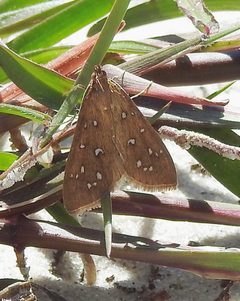
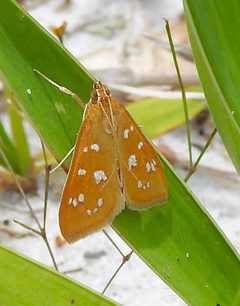
Diastictis argyralis is a small crambid native to North America, commonly known as the white-spotted orange moth. First described by Jacob Hübner in 1818, this is recognized by its orange forewings marked with white spots. It exhibits notable geographic variation in period duration, with in Florida active nearly year-round while northern populations have a more restricted season.
Pronunciation
How to pronounce Diastictis argyralis: /daɪ.ˈæs.tɪk.tɪs ˌɑːr.dʒɪˈreɪ.lɪs/
These audio files are automatically generated. While they are not always 100% accurate, they are a good starting point.
Identification
The combination of small size (~21 mm wingspan), orange ground color on forewings, and contrasting white spots distinguishes this from most similar crambid . The specific pattern and placement of white spotting may aid separation from in the Diastictis, though detailed comparative references for this genus are limited in the provided sources.
Images
Appearance
Small with wingspan approximately 21 mm. Forewings orange with distinct white spotting. Overall coloration provides the basis for its .
Distribution
North America. Recorded from Colorado, Florida, Georgia, Indiana, Maine, Maryland, Mississippi, North Carolina, Ohio, Ontario, South Carolina, Tennessee, Texas, Virginia, and Vermont.
Seasonality
active May to August across most of range. In Florida, active March to December, representing an extended season in subtropical conditions.
Similar Taxa
- Other Diastictis species share general body plan and may overlap in distribution; precise differentiation requires examination of wing pattern details and genitalia
More Details
Taxonomic history
Described by Jacob Hübner in 1818, placing it among the earlier-named North American crambid .