
Helvibotys pucilla
Druce, 1895
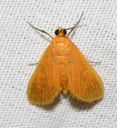
Helvibotys pucilla is a small crambid first described by Herbert Druce in 1895. It has a transcontinental distribution spanning Central America and the southern United States. are active during late spring and summer months.
Pronunciation
How to pronounce Helvibotys pucilla: /hɛl.viˈbo.tɪs puˈsi.lə/
These audio files are automatically generated. While they are not always 100% accurate, they are a good starting point.
Identification
Small size (15–18 mm wingspan) and uniform brownish yellow wings in males. The combination of diminutive stature, plain coloration, and geographic occurrence in the southern United States and Central America distinguishes it from similar North American crambids. Females may differ in coloration, but this has not been documented.
Images
Appearance
Small with wingspan of 15–18 mm. Males have forewings and hindwings that are uniform brownish yellow. in coloration has not been described.
Distribution
Guatemala, Rica, Mexican state of Veracruz, and United States (Kentucky, Oklahoma, Texas).
Seasonality
have been recorded on wing from May to August.
Similar Taxa
- Other Helvibotys speciesSimilar size and general ; precise identification requires examination of genitalia or molecular data.
- Small Pyraustinae speciesPlain brownish yellow coloration overlaps with numerous small crambid ; geographic range and male-specific wing coloration may aid separation.
More Details
Taxonomic history
Described by Herbert Druce in 1895, originally placed in a different before transfer to Helvibotys.
Observation frequency
Only 17 observations recorded on iNaturalist as of source date, suggesting it is rarely encountered or underreported.