
Helvibotys helvialis
Walker, 1859
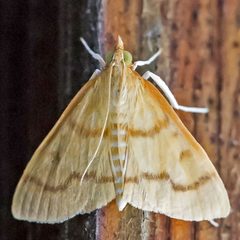
Helvibotys helvialis is a crambid described by Francis Walker in 1859. It is widespread across North America, ranging from California to Florida and northward to eastern Canada and the Midwest. The exhibits in wingspan, with males slightly larger than females. Larvae are associated with amaranths and beets.
Pronunciation
How to pronounce Helvibotys helvialis: /hɛl.viˈbɔt.ɪs hɛl.viˈa.li.əs/
These audio files are automatically generated. While they are not always 100% accurate, they are a good starting point.
Identification
Distinguished from similar crambid by its documented North American distribution and association with Amaranthus and Beta . Precise diagnostic characters require examination of genitalia or molecular analysis, as external overlaps with related Pyraustinae .
Images
Appearance
Small with wingspan of 18–20 mm in males and 16–20 mm in females. Specific coloration and pattern details are not documented in available sources.
Habitat
supporting larval plants, including agricultural fields and disturbed areas where Amaranthus and Beta vulgaris occur.
Distribution
North America: California to Florida; northward in the eastern United States to Massachusetts, Quebec, Ontario, Michigan, and Iowa.
Seasonality
active from April to September.
Diet
Larvae feed on Amaranthus and Beta vulgaris (common beet). feeding habits are not documented.
Host Associations
- Amaranthus - larval food plantmultiple
- Beta vulgaris - larval food plantcommon beet
Life Cycle
Complete with documented larval and stages. Specific details on , pupal stages, and number of per year are not available.
Ecological Role
Herbivore; larvae consume weedy Amaranthus and cultivated beets, potentially serving as a minor agricultural pest.
Human Relevance
Minor agricultural pest on Beta vulgaris (beet crops). No significant economic impact documented.
Similar Taxa
- Other Helvibotys species-level similarity in ; requires dissection or molecular methods for reliable identification.
- Pyraustinae crambidsShared characteristics including wing venation and body form; precise identification relies on genitalia examination.
More Details
Taxonomic history
Originally described as Spilodes helvialis by Walker in 1859; later transferred to Helvibotys.