
Fumibotys fumalis
Guenée, 1854
Mint Root Borer Moth
Pronunciation
How to pronounce Fumibotys fumalis: /ˌfjuːmɪˈboʊtɪs fjuːˈmælɪs/
These audio files are automatically generated. While they are not always 100% accurate, they are a good starting point.
Identification
The combination of small size, brownish-gray forewings with variable dark markings, and association with mint helps distinguish this from similar small crambid . The smoky, somewhat uniform forewing coloration with subtle patterning is characteristic. Genitalia examination may be required for definitive identification from closely related species.
Images
Appearance
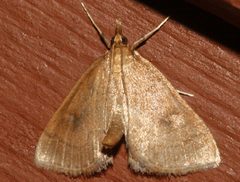
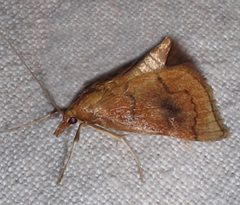
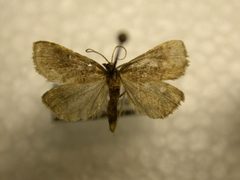
are small with wingspan approximately 15–20 mm. Forewings are brownish-gray with variable darker markings and a somewhat triangular shape. Hindwings are paler, often grayish-white. The overall coloration is muted and smoky, consistent with the epithet 'fumalis' (smoky).
Habitat
Associated with mint-growing areas including cultivated mint fields, wetlands, and moist meadows where mint plants occur. Larval is within soil around mint root systems.
Distribution
Recorded across most of North America including southern Canada (Alberta, Manitoba, Saskatchewan) and the United States. Distribution corresponds with the range of mint plants.
Seasonality
are active during the warmer months; specific period varies by latitude. In northern regions, activity is concentrated in mid-summer.
Diet
Larvae feed on roots and rhizomes of mint plants (Mentha ). do not feed.
Host Associations
- Mentha - larval food plantMint ; larvae bore into roots and rhizomes
Life Cycle
Complete with , larva, pupa, and stages. Larvae are root-borers, feeding internally on mint root tissue. occurs in soil. Adults emerge to mate and lay eggs near plants.
Behavior
Larvae are concealed feeders, tunneling within mint roots and rhizomes. are and attracted to light. Females lay on or near mint plants.
Ecological Role
As a herbivore on mint plants, larvae may influence mint plant and . In cultivated settings, can reach pest densities. Provides food source for and .
Human Relevance
Economic pest of cultivated mint, particularly in the Pacific Northwest mint-growing regions of the United States. Larval feeding damages root systems, reducing plant vigor and oil yield. Management is important in commercial mint production.
Similar Taxa
- Other small Crambidae in PyraustinaeSimilar size and general appearance; distinguished by association with mint and subtle wing pattern differences
- Other root-boring moth larvaeSimilar concealed feeding habit; distinguished by specificity to Mentha
More Details
Pest Management
In commercial mint production, monitoring and management of Fumibotys fumalis is practiced. Larval feeding reduces yield and plant stand longevity. Control strategies include crop , clean , and targeted applications.
Taxonomic Note
Originally described as Ebulea fumalis before transfer to Fumibotys. The Fumibotys is , containing only this single .