
Evergestis unimacula
Grote & Robinson, 1867
Large-spotted Evergestis Moth
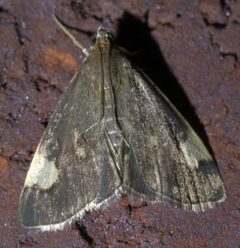
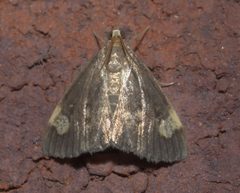
Evergestis unimacula is a of crambid known as the Large-spotted Evergestis Moth. The species was described by Grote and Robinson in 1867. Its specific epithet refers to the Latin 'unimacula' meaning 'one spot', likely referencing a distinctive marking on the forewing. The species is recorded from the eastern and central United States and adjacent Canada.
Pronunciation
How to pronounce Evergestis unimacula: //ˌɛvəˈdʒɛstɪs juːnɪˈmækjʊlə//
These audio files are automatically generated. While they are not always 100% accurate, they are a good starting point.
Identification
The name 'unimacula' (one spot) suggests a diagnostic single spot on the forewing, though detailed wing pattern descriptions are not available in the provided sources. As a member of the Evergestinae , it likely shares the broad, somewhat triangular forewing shape typical of the group. Distinguishing features from congeneric species such as Evergestis rimosalis would require examination of genitalia or precise spot pattern.
Images
Distribution
Eastern and central North America. Recorded from Georgia, Illinois, Indiana, Iowa, Maryland, Michigan, North Carolina, Ohio, Oklahoma, Ontario, Pennsylvania, Quebec, Tennessee, West Virginia, and Vermont. Outlier records exist from Florida.
Similar Taxa
- Evergestis rimosalisSimilar size and general appearance in the Evergestinae ; separation requires detailed examination of wing pattern and genitalia.
More Details
Etymology
The specific epithet 'unimacula' derives from Latin, combining 'uni-' (one) and 'macula' (spot), referring to a single distinctive spot on the forewing.