
Evergestis pallidata
Hufnagel, 1767
Purple-backed Cabbageworm Moth
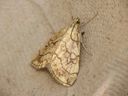
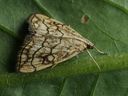
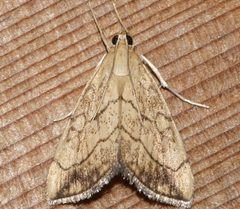
Evergestis pallidata is a crambid with a broad distribution across Europe, the Palearctic, and North America. are recognized by their distinctive yellow forewings marked with brown-red transverse lines and creating a mesh pattern, contrasting with white hindwings. The is to depending on latitude, with activity peaking in mid-summer. Larvae are on Brassicaceae, particularly Barbarea vulgaris.
Pronunciation
How to pronounce Evergestis pallidata: /ˌɛvəˈɡɛstɪs ˌpælɪˈdeɪtə/
These audio files are automatically generated. While they are not always 100% accurate, they are a good starting point.
Identification
The combination of yellow forewings with a brown-red mesh pattern and white hindwings distinguishes this from other Evergestis. The wingspan of 24–29 mm separates it from larger congenerics. Similar species in the typically lack the conspicuous white hindwing ground color. The brown-red transverse lines are more pronounced and complete than in Evergestis forficalis, which has more diffuse markings.
Images
Habitat
Found in open including meadows, field margins, and disturbed ground where plants occur. Associated with moist to mesic conditions supporting Brassicaceae vegetation. Elevational range extends from lowlands to montane zones.
Distribution
Europe (widespread), across the Palearctic including Northern Asia, and North America. Records confirmed from Belgium at national and regional levels.
Seasonality
period from June to September, with timing varying by geographic location. Likely single in northern parts of range, possibly partial second generation in southern areas.
Diet
Larvae feed on Brassicaceae , with documented specialization on Barbarea vulgaris (wintercress). feeding habits not documented.
Host Associations
- Barbarea vulgaris - larval food plantprimary
- Brassicaceae - larval food plant general association
Life Cycle
Complete with , larva, pupa, and stages. Larval development occurs on Brassicaceae plants. stage not explicitly documented in sources.
Behavior
are and attracted to light. Larval includes feeding on foliage and stems of plants.
Ecological Role
Larval herbivore on Brassicaceae; contributes to nutrient cycling in early successional and disturbed . Potential prey for .
Human Relevance
Minor potential agricultural relevance as a Brassicaceae feeder, though not documented as a significant pest. Subject of citizen science observation and recording.
Similar Taxa
- Evergestis forficalissimilar size and yellow forewing ground color, but lacks white hindwings and has more diffuse, less complete transverse lines
- Other Evergestis speciesdistinguished by the unique combination of mesh-patterned yellow forewings and white hindwings
More Details
Taxonomic authorship
Authorship sometimes cited as Hufnagel, 1767 or Hufnagel, 1811 in different sources; 1767 is the accepted date in modern databases.
Observation frequency
Over 3,700 observations documented on iNaturalist, indicating well-recorded status in regions with active naturalists.