
Catoptria
Hübner, 1825
Species Guides
3- Catoptria latiradiellus(Two-banded Catoptria Moth)
- Catoptria oregonicus(Western Catoptria)
- Catoptria trichostomus
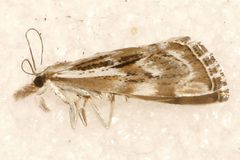
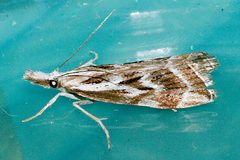
Catoptria is a of grass moths in the Crambidae, established by Hübner in 1825. The genus contains multiple distributed across the Palaearctic region, with particular diversity in the Western Balkans. Recent taxonomic revisions have clarified species boundaries within the C. coulonellus species group through integrative approaches combining and .
Pronunciation
How to pronounce Catoptria: /kəˈtɒp.tri.ə/
These audio files are automatically generated. While they are not always 100% accurate, they are a good starting point.
Identification
Members of Catoptria are grass moths (Crambinae) and can be distinguished from related through genitalia , particularly male valvae structure and female sterigma configuration. -level identification often requires examination of genitalia; external morphology alone is frequently insufficient due to similarity among . The C. coulonellus species group has been subject to recent revision, with neotypes designated to stabilize .
Images
Habitat
Grassland ; specific microhabitat associations vary by but generally tied to grassy environments given the 'grass moths' applied to members of this .
Distribution
Palaearctic region with records from Scandinavia (Denmark, Norway, Sweden), Western Balkans, and North America (Vermont, USA). Distribution varies considerably by ; some such as C. trichostoma have Holarctic ranges.
Similar Taxa
- Other Crambinae generaCatoptria shares the grass moth with related in Crambinae; distinguished by genitalia characters and specific wing pattern elements.
More Details
Taxonomic history
The has undergone significant revision, particularly the C. coulonellus group. Recent work (2023) described five new species from the Western Balkans (C. nikai, C. richteri, C. korab, C. plat, C. sarplanina), reinstated C. coulonellus, and established C. petrificella as a junior synonym of C. combinella.
Sources and further reading
- BugGuide
- Wikipedia
- GBIF taxonomy match
- iNaturalist taxon
- NCBI Taxonomy
- Catalogue of Life
- NEW DATA ON THE DISTRIBUTION OF CATOPTRIA TRICHOSTOMA, THE LITTLE-KNOWN SPECIES OF GRASS MOTHS (LEPIDOPTERA: PYRALOIDEA, CRAMBIDAE), IN PALAEARCTIC REGION
- Taxonomic and nomenclatorial notes on the Catoptria coulonellus (Duponchel) species group with description of five new species from Western Balkans (Lepidoptera: Pyraloidea, Crambidae)