
Eoparargyractis plevie
Dyar, 1917
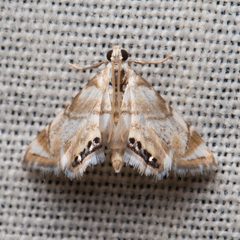
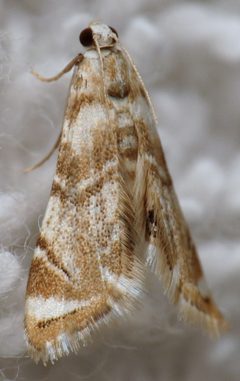
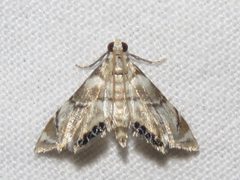
Eoparargyractis plevie is a small aquatic in the Crambidae, described by Harrison Gray Dyar Jr. in 1917. The is notable for its entirely aquatic larval stage, during which it feeds on submerged aquatic plants. are active from spring through fall across eastern North America.
Pronunciation
How to pronounce Eoparargyractis plevie: //iː.oʊˌpærəˌdʒɪrˌæktɪs ˈplɛ.vi.iː//
These audio files are automatically generated. While they are not always 100% accurate, they are a good starting point.
Identification
Larvae are distinguished by their yellow and aquatic ; they are the only known crambid larvae in eastern North America that feed on Isoetes and Lobelia dortmanna. may be separated from other Eoparargyractis by genitalia examination, though specific diagnostic features for field identification are not documented.
Images
Habitat
Aquatic environments supporting the plants Lobelia dortmanna, Isoetes tuckermani, and Isoetes muricata; larvae occur in submerged vegetation at the base of plant rosettes.
Distribution
Eastern North America: recorded from Florida, Maine, Massachusetts, New Hampshire, New York, South Carolina, Vermont (US), Nova Scotia, and Quebec.
Seasonality
active April through October; larvae present August to mid-November; overwinters as larvae.
Diet
Larvae feed on submerged aquatic plants: Lobelia dortmanna, Isoetes tuckermani, and Isoetes muricata. diet unknown.
Host Associations
- Lobelia dortmanna - larval food plantsubmerged aquatic plant
- Isoetes tuckermani - larval food plantsubmerged aquatic quillwort
- Isoetes muricata - larval food plantsubmerged aquatic quillwort
Life Cycle
not described. Larvae are aquatic, present August to mid-November, reaching 11 mm at maturity. Overwinters in larval stage. occurs in a cocoon spun on a leaf at the base of the plant rosette. emerge April to October.
Behavior
Larvae are aquatic and feed on submerged portions of plants. occurs within a silken cocoon attached to host vegetation underwater or at the water-substrate interface.
Ecological Role
Herbivore in aquatic ; specialized consumer of Isoetes and Lobelia dortmanna, potentially contributing to nutrient cycling in oligotrophic aquatic .
Human Relevance
No documented economic or medical significance. May serve as an for healthy aquatic supporting rare plants like Isoetes.
Similar Taxa
- Other Eoparargyractis species share aquatic larval habits but differ in plant associations and geographic distribution; genitalia examination required for definitive separation
- Other Acentropinae contains many aquatic , but E. plevie is distinguished by specific plant associations with Isoetes and Lobelia dortmanna
More Details
Aquatic Adaptation
The represents a fully aquatic unusual among Lepidoptera, with larvae, pupae, and presumably all occurring in submerged or water-margin .