
Buckleria parvulus
(Barnes & Lindsey, 1921)
Sundew Plume Moth
Buckleria parvulus, commonly known as the sundew , is a minute plume moth in the Pterophoridae. First described in 1921 (though some sources cite 1965 for a later reclassification or redescription), it is among the smallest members of its family. The is notable for its highly specialized larval diet: it feeds exclusively on sundews (Drosera species), making it one of the few insects adapted to consume these plants. Its distribution is restricted to the southeastern United States.
Pronunciation
How to pronounce Buckleria parvulus: /bʊˈklɛɹiə ˈpɑrvjʊləs/
These audio files are automatically generated. While they are not always 100% accurate, they are a good starting point.
Identification
The extremely small size (wingspan ~12 mm) distinguishes this from most other plume moths in its range. The combination of minute size and association with Drosera plants provides a strong diagnostic clue. Definitive identification requires examination of genitalia or reference to original description by Barnes and Lindsey.
Images
Appearance
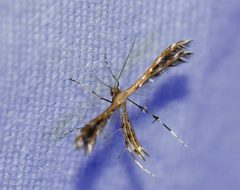
A very small with an average wingspan of approximately 12 mm. The wings are deeply divided into feathery plumes, characteristic of the Pterophoridae. The overall body size is diminutive, consistent with the specific epithet "parvulus" (meaning tiny or small).
Habitat
Occurs in where sundew grow, including wet pine flatwoods, seeps, bogs, and moist sandy areas. The presence of plants Drosera brevifolia, D. intermedia, and D. filiformis dictates local distribution within the southeastern coastal plain.
Distribution
Southeastern United States: documented from Florida (type locality at Archbold Biological Station), North Carolina, Louisiana, Alabama, Georgia, Mississippi, South Carolina, and Texas.
Diet
Larvae feed on glandular trichomes, leaves, and flowers of sundew (Drosera brevifolia, Drosera intermedia, and Drosera filiformis). feeding habits are not documented.
Host Associations
- Drosera brevifolia - larval feeds on glandular trichomes, leaves, and flowers
- Drosera intermedia - larval feeds on glandular trichomes, leaves, and flowers
- Drosera filiformis - larval feeds on glandular trichomes, leaves, and flowers
Ecological Role
A herbivore adapted to consume plants. The ability to feed on Drosera glandular trichomes—structures that trap and digest insects—represents a remarkable evolutionary . The ecological impact is likely limited by the 's small size and localized abundance.
Human Relevance
No direct economic or agricultural significance. Of scientific interest due to its specialized relationship with plants. The may serve as a model for studying biochemical adaptations that allow herbivory on plants with insect-trapping defenses.
Similar Taxa
- Other Buckleria speciesOther members of the also specialize on Drosera; identification requires careful morphological comparison or genitalia examination.
- Other Oxyptilini plume mothsMany are small and share general ; plant association and minute size help narrow identification.
More Details
Taxonomic history
Originally described as Trichoptilus parvulus by Barnes and Lindsey in 1921, later transferred to Buckleria. Some sources incorrectly cite 1965 as the description date; this likely reflects a later redescription or the 1965 publication date of a subsequent work by the same authors.
Specialized feeding adaptation
The consumption of Drosera glandular trichomes is highly unusual. Most insects are trapped and digested by these structures; B. parvulus larvae have evolved or resistance to the sticky mucilage and digestive that make sundews .