
Calephelis rawsoni
McAlpine, 1939
Rawson's metalmark
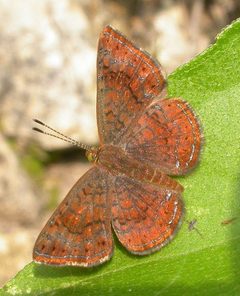
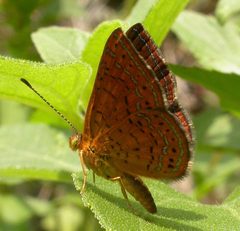
Calephelis rawsoni, commonly known as Rawson's metalmark, is a small riodinid described by Wilbur S. McAlpine in 1939. It inhabits moist, shaded environments in the southwestern United States and Mexico. The is notable for its restricted association with specific larval plants in the Eupatorium.
Pronunciation
How to pronounce Calephelis rawsoni: //kæˈlɛfɪlɪs ˈrɔːsən.aɪ//
These audio files are automatically generated. While they are not always 100% accurate, they are a good starting point.
Identification
Distinguished from other Calephelis by geographic range and preference for moist, shaded environments rather than open arid habitats. Specific wing pattern differences from such as Calephelis nemesis (Fatal Metalmark) are not documented in available sources. Accurate identification may require examination of genitalic structures or molecular analysis.
Images
Appearance
Wingspan measures 19–29 mm (3⁄4–1⅛ inches). As a , it likely exhibits the characteristic metallic spots or bands typical of the Riodinidae, though specific wing pattern details for this are not documented in available sources.
Habitat
Moist areas including stream edges, gulches, subtropical woodland, and shaded limestone outcrops. The shows a strong association with shaded, humid microhabitats within otherwise arid or semi-arid regions.
Distribution
Southern Arizona, south and west Texas, south to central Mexico.
Diet
Larvae feed on Eupatorium havanense and Eupatorium greggii (Asteraceae). feeding habits are not documented.
Host Associations
- Eupatorium havanense - larval food plantVerified
- Eupatorium greggii - larval food plantVerified
Life Cycle
Complete with , larva, pupa, and stages. Specific details of voltinism, stage, or developmental duration are not documented.
Ecological Role
likely serve as . Larvae function as herbivores on Eupatorium . The species contributes to riodinid diversity in subtropical woodland .
Human Relevance
No documented economic or cultural significance. Of interest to enthusiasts and researchers studying riodinid and plant relationships.
Similar Taxa
- Calephelis nemesisOverlaps in range; Fatal Metalmark occurs in similar regions but typically in more open
- Calephelis perditalis with similar size and preferences in parts of shared range
- Apodemia palmeriPalmer's Metalmark is sympatric in Arizona and Texas; distinguished by different plant associations and preferences
More Details
Taxonomic history
Described by Wilbur S. McAlpine in 1939, representing one of numerous Calephelis described in the early-to-mid 20th century as the was revised.
Conservation status
Not formally assessed; appears to have stable within its restricted range based on iNaturalist observation records.