
Colias alexandra
Edwards, 1863
Queen Alexandra's Sulphur, Alexandra Sulphur, Ultraviolet Sulfur
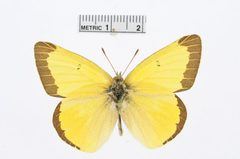
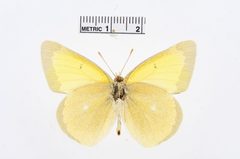
Colias alexandra is a pierid of western North America with a wingspan of 38–57 mm. Males display yellow to orange-yellow upper wings with distinctive ultraviolet patterns used in mate recognition; females are lighter yellow with variable dark markings. The exhibits complex driven primarily by weather-related reductions in natality and larval mortality. are active from mid-May through August, with larvae feeding on leguminous plants including Thermopsis, Astragalus, Lathyrus, Oxytropis, and Lupinus.
Pronunciation
How to pronounce Colias alexandra: /ˈko.li.as æ.lɛkˈsæn.dra/
These audio files are automatically generated. While they are not always 100% accurate, they are a good starting point.
Identification
Distinguished from Colias philodice by more yellow ground color in males and especially by the silver grey hindwing underside with silvery spot (vs. different underwing pattern in philodice). Females differ from C. philodice in having reduced or absent dark margin on forewing. Previously considered with Colias christina, but separated based on geographic distribution, preferences, female wing pattern, and male ultraviolet wing patterns. Sympatric with Colias occidentalis in parts of range; distinguished by wing pattern and habitat association.
Images
Habitat
Rocky mountain meadows and subalpine zones. Specific preferences differ from and contributed to -level separation from C. christina. Oviposition sites and nectar sources affected by weather conditions including unseasonal snow and drought.
Distribution
Western North America from Alaska and Northwest Territories south to Arizona and New Mexico. Documented in Canadian provinces: Alberta, Saskatchewan, Manitoba, British Columbia. with more restricted ranges: C. a. alexandra (Utah, Wyoming, Colorado, Montana, South Dakota, Nebraska, Alberta, Saskatchewan); C. a. apache (Arizona, New Mexico); C. a. columbiensis (British Columbia, Alberta, Washington, Idaho, Montana); C. a. edwardsii (Nevada, California, Oregon, Idaho, Washington).
Seasonality
period mid-May until August. in at least some (single per year with larval ).
Diet
Larvae feed on Thermopsis, Astragalus, Lathyrus, Oxytropis, and Lupinus (Fabaceae). nectar sources not specified by species but referenced as affected by weather conditions.
Host Associations
- Thermopsis - larval food plant
- Astragalus - larval food plant
- Lathyrus - larval food plant
- Oxytropis - larval food plant
- Lupinus - larval food plant
Life Cycle
with obligate larval . → larva (with diapause) → . to adulthood approximately 1.2% based on 1975–1979 study. Egg distribution patterns vary inter-annually between contagious/clumped (1976–1979) and random (1981). Within clumped egg masses, first-laid eggs have approximately 2× greater survivorship to diapause than subsequently laid eggs.
Behavior
No -recognition observed (unlike some other pierid ). Oviposition sensitive to weather conditions; poor weather during oviposition period reduces natality. subject to collection pressure at some study sites. Larval is a key stage affecting .
Human Relevance
Subject to collection pressure at Rocky Mountain Biological Laboratory study site, where removal by collectors contributed to mortality in studies.
Similar Taxa
- Colias philodiceMales similar in upperwing appearance but distinguished by underwing pattern and ground color gloss
- Colias christinaFormerly considered ; separated based on geographic distribution, preferences, female wing pattern, and male ultraviolet patterns
- Colias occidentalisClosely related and sympatric; distinguished by wing pattern and association
More Details
Population Ecology
Long-term study (1975–1979) at Rocky Mountain Biological Laboratory used key factor analysis to identify drivers of change. Reduced natality (primarily from weather effects on oviposition and nectar availability) and larval mortality (secondarily) were principal determinants of population trends, while mortality, pre-diapause larval mortality, and post-diapause mortality contributed little.
Taxonomic History
boundaries clarified by Ferris through studies of geographic distribution, preferences, female wing pattern, and male ultraviolet wing patterns, establishing C. alexandra and C. christina as separate species.
Sources and further reading
- BugGuide
- Wikipedia
- GBIF taxonomy match
- iNaturalist taxon
- NCBI Taxonomy
- Catalogue of Life
- A Butterfly Invasion in Yolo, Solano and Sacramento Counties | Bug Squad
- Why This Honey Bee Research Is So Important | Bug Squad
- 'Battus philenor! Battus philenor!' | Bug Squad
- A Boy, Bugs, a Birthday and the Bohart | Bug Squad
- Acta Biologica Sibirica | Blog
- Mosquito Meal: Study Shows Pests' Potential as Livestock Feed
- Egg distribution and survivorship in the pierid butterfly, Colias alexandra
- The population ecology of a natural population of the pierid butterfly Colias alexandra