
Limenitis weidemeyerii
(Edwards, 1861)
Weidemeyer's Admiral
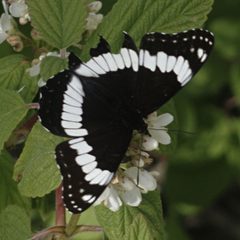
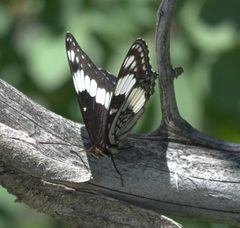
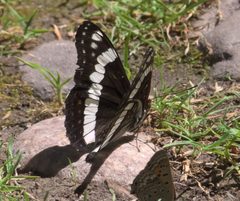
Weidemeyer's Admiral is a medium-sized in the brush-footed Nymphalidae, found across western North America from the Rocky Mountains to the Sierra Nevada and California. display distinctive black and white wing patterns with rows of white spots, while the surface shows brown with gray marginal markings. The is named after 19th-century entomologist John William Weidemeyer, whose Rocky Mountain specimen was used for the original description. Larvae develop on woody plants in the Populus, Salix, Holodiscus, and Amelanchier, while adults feed on tree sap, carrion, and flower nectar.
Pronunciation
How to pronounce Limenitis weidemeyerii: /lɪˈmɛnɪtɪs ˌvaɪdəˈmaɪərɪaɪ/
These audio files are automatically generated. While they are not always 100% accurate, they are a good starting point.
Identification
Distinguished from similar Limenitis by geographic range and wing pattern details. White Admiral (Limenitis arthemis) occurs in eastern and northern North America with overlapping but more northerly distribution; arthemis and rubrofasciata show different patterning with red-orange basal bands lacking in L. weidemeyerii. Lorquin's Admiral (L. lorquini) of Pacific coastal regions has orange-brown rather than white markings on surface and more extensive orange on forewing apex. Viceroy (L. archippus) is smaller with narrower black bands and single row of white spots. Red-spotted Purple (L. arthemis astyanax) lacks white bands entirely, showing iridescent blue instead.
Images
Habitat
Occupies diverse across western montane and intermountain regions including riparian corridors, open woodlands, forest edges, and canyon bottoms. Associated with presence of larval plants: aspen and cottonwood (Populus spp.), willows (Salix spp.), oceanspray (Holodiscus), and serviceberries (Amelanchier). Found from lower elevations up to subalpine zones where host plants occur. Particularly common in pinyon-juniper woodland transitions to ponderosa pine and Gambel oak zones, as well as along creekside vegetation corridors.
Distribution
Western North America from western Canada (Alberta, Saskatchewan) through the northern Great Plains (outlying ) and Western United States. Core range extends from Rocky Mountains westward across the Great Basin to Sierra Nevada and California. Absent from Pacific coastal plain where replaced by L. lorquini. Occurs north to southern Canadian prairies, south through Utah, Arizona, New Mexico, with scattered records in appropriate montane .
Seasonality
Single-brooded in northern portions of range; active primarily June through August depending on elevation and latitude. Lower elevation may show extended period from late May into September. stage as larva, with in spring. Adult timed to coincide with availability of sap flows and peak flowering of nectar sources.
Diet
Larvae feed on leaves of woody plants: aspen and cottonwood (Populus tremuloides, P. deltoides and relatives), willows (Salix spp.), oceanspray (Holodiscus discolor), and serviceberry/shadbush (Amelanchier alnifolia and relatives). feed on tree sap (particularly from wounds on Populus and other trees), carrion, and flower nectar. Documented visiting flowers of Eriodictyon angustifolium and other montane forbs.
Host Associations
- Populus tremuloides - larval quaking aspen
- Populus deltoides - larval cottonwood
- Salix - larval willows, multiple
- Holodiscus discolor - larval oceanspray
- Amelanchier alnifolia - larval serviceberry/shadbush
Life Cycle
Holometabolous with complete . laid singly or in small groups on plant foliage. Larvae feed externally on leaves, constructing characteristic leaf shelters by folding or tying leaves with silk. Overwinter as partially grown larvae in . occurs in spring on host plant or nearby vegetation, with emerging in early summer. Single per year in most of range; no evidence of partial second even in southern portions.
Behavior
perch on tree trunks and foliage with wings closed, displaying cryptic brown surface. When disturbed, may open wings to flash contrasting black-and-white pattern. Strong, direct typical of admirals, often patrolling territories along streams and forest edges. Males establish and defend territories, chasing intruders including other butterflies and insects. Adults frequently found on ground at sap flows or carrion, and will visit moist soil for minerals. Not known to migrate; resident within suitable patches.
Ecological Role
Larval herbivore on woody riparian and montane shrubs and trees; minor defoliator with limited economic impact. serves as of montane flowering plants. Prey item for birds, spiders, and predatory insects. Documented as prey for robber flies (Asilidae: Promachus hinei). Contributes to nutrient cycling through larval feeding and adult carrion-feeding .
Human Relevance
Subject of recreational observation and photography by enthusiasts. Occasionally reared by hobbyists from wild-collected larvae. No significant agricultural or forestry impact. Named for 19th-century entomologist John William Weidemeyer, honoring contributions to early North American lepidopterology. Featured in regional field guides to western butterflies.
Similar Taxa
- Limenitis arthemisWhite Admiral occurs in eastern/northern North America with overlapping range in north; differs in hindwing pattern with red-orange basal band and more extensive white on surface
- Limenitis lorquiniLorquin's Admiral of Pacific coastal regions; has orange-brown markings rather than white, more extensive orange on forewing apex, and different pattern
- Limenitis archippusViceroy is smaller with narrower black bands, single row of white spots, and more linear wing shape; also differs in larval (willows and poplars vs. primarily Salicaceae and Rosaceae)
More Details
Etymology
Named after John William Weidemeyer (1826-1866), German-born American entomologist who collected extensively in the Rocky Mountains. The was collected by Weidemeyer in the Rocky Mountains and described by William Henry Edwards in 1861.
Field observation notes
Observed in Leeds Canyon, Utah, nectaring on flowers of Eriodictyon angustifolium in pinyon/juniper-Gambel oak transition zone, and along roadside through Gambel oak woodland (Ted C. MacRae field notes, June 2023).