
Limenitis archippus watsoni
(Dos Passos, 1938)
Watson's Gulf Coast Viceroy
Limenitis archippus watsoni is a of the viceroy found in central North America. It is part of the well-known mimicry complex with the monarch butterfly, though recent research suggests viceroys may also be unpalatable to . This subspecies is distinguished from other viceroy by geographic range and subtle morphological differences.
Pronunciation
How to pronounce Limenitis archippus watsoni: /lɪˈmɛnɪtɪs ˈɑrkɪpəs ˈwɑtsəni/
These audio files are automatically generated. While they are not always 100% accurate, they are a good starting point.
Identification
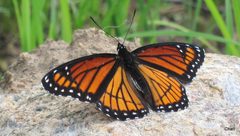
The submarginal semi-circular black line across the hindwing is a consistent distinguishing feature from the monarch butterfly. Males patrol territories and perch frequently, not reliably observed in monarchs. Compared to the nominate eastern , L. a. watsoni from the Great Plains region shows variation in size and coloration.
Images
Distribution
Central North America including the Canadian provinces of Alberta, Manitoba, and Saskatchewan, and the Great Plains region of the United States.
Diet
nectar on milkweeds, thistles, and other common flowers. Larvae feed on willows (Salix), poplars, and cottonwoods (Populus), sequestering salicylic acid that makes them unpalatable to .
Life Cycle
Complete with , larva, pupa, and stages. Caterpillars resemble bird droppings as camouflage.
Behavior
Males are territorial, actively patrolling and perching to defend areas. Both sexes exhibit mimicry-related patterns.
Ecological Role
Participant in Müllerian mimicry complex with , contributing to education regarding unpalatable prey. Larval feeding on Salicaceae may influence plant chemistry dynamics.
Human Relevance
Occasionally mistaken for by observers. Subject of ecological and evolutionary research on mimicry. Not known to be of economic importance.
Similar Taxa
- Limenitis archippus archippusThe nominate eastern ; differs in geographic range and subtle morphological variation
- Danaus plexippusMonarch butterfly; lacks the submarginal hindwing line and does not exhibit territorial perching
Sources and further reading
- BugGuide
- GBIF taxonomy match
- iNaturalist taxon
- NCBI Taxonomy
- Catalogue of Life
- 'Fourteen' Is a Lucky Number: That's Where the Monarchs Are | Bug Squad
- 'Eyes on the Butterflies' at the Bohart Museum of Entomology | Bug Squad
- The Monarchs at the Bohart Museum of Entomology | Bug Squad
- Bug Eric: Bosque del Apache National Wildlife Refuge
- The Growing Utility of Online Photo Sharing for Entomology Research
- Bug Eric: January 2016