
Heliconius erato
(Linnaeus, 1758)
red postman, small postman, red passion flower butterfly, crimson-patched longwing
Heliconius erato is a neotropical renowned for its exceptional longevity among butterflies, living up to six months in the wild and over 186 days in captivity. This extended lifespan is enabled by its unique ability among butterflies to digest pollen, extracting through specialized . The exhibits Müllerian mimicry with co-occurring Heliconius species, particularly H. melpomene, sharing aposematic warning coloration to deter . display remarkable philopatry, maintaining restricted home ranges sometimes separated by only 30 yards from neighboring territories. The species was described by Linnaeus in 1758 and comprises numerous geographically variable divided into eastern and western Andean clades.
Pronunciation
How to pronounce Heliconius erato: /ˌhɛlɪˈkoʊniəs ˈɛrətoʊ/
These audio files are automatically generated. While they are not always 100% accurate, they are a good starting point.
Identification
Distinguished from other Heliconius by specific regional wing pattern combinations that match local Müllerian mimicry rings; identification to level requires geographic context and pattern analysis. H. erato chestertonii is identifiable by its unique blue coloration lacking red markings. Distinguished from H. melpomene by genetic and subtle morphological differences despite extensive pattern mimicry; H. erato typically has more extensive red on forewing and different hindwing ray patterns in most subspecies. Larvae distinguished by white body with black and orange spots in final instar, with subspecies-specific markings such as the dark lateral stripe in H. erato chestertonii.
Images
Appearance
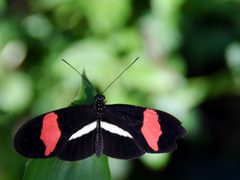
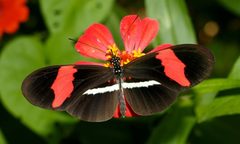
wingspan ranges from 6.7 to 8.0 cm. Wing patterns highly variable across , typically featuring red coloration in combinations with black, yellow, or white. Common pattern elements include red forewing patches ('dennis') and red hindwing lines ('ray'), though some subspecies display yellow or white markings instead. H. erato chestertonii uniquely lacks red entirely, displaying blue coloration. Males possess androconial on the subcostal region of hindwings and for dissemination. Yellow hindwing bars contain 3-hydroxy-DL-kynurenine (3-OHK) pigment, which reflects both ultraviolet and long-wavelength light. Larvae: early instars discrete with small dark prothoracic plate; fifth instar white with black and orange spots, black spikes, and yellow . Pupae camouflaged on plant stems with defensive spikes, varying in color from light to dark.
Habitat
Edges of tropical rainforests throughout the neotropics. Occupies forest edge where passion vines grow. Highly philopatric with restricted home ranges; in high- of Trinidad, home ranges may be separated by only 30 yards. rarely travel to neighboring home ranges. Communal roosting sites typically located 2–10 meters above ground on twigs and tendrils.
Distribution
Neotropical region from southern Texas through Central America to northern Argentina and Paraguay. Two major genetic clades separated by the Andes: eastern clade (Amazonia, southeastern Brazil, Guiana) including dingus, emma, lativitta, phyllis, notabilis, favorinus, erato, hydara, venustus; western clade (Central America, Pacific slope of South America) including petiverana, hydara, venus, guarica, cyrbia. Subspecies H. erato chestertonii restricted to Cauca Valley, Colombia.
Seasonality
active year-round in tropical . Longevity exceptional: minimum 20 days documented in wild, typically 3–6 months, with captive records exceeding 186 days. Continuous possible due to pollen-feeding enabling extended female .
Diet
: uniquely among butterflies, actively collects and digests pollen as primary protein source, particularly from camara. Pollen collected on surface, agitated by repeated coiling/uncoiling to release (arginine, leucine, lysine, valine, proline, histidine, isoleucine, methionine, phenylalanine, threonine, tryptophan). Minimal nectar feeding (few seconds per flower). Larvae: feed on passion vine (Passiflora) leaves, initially consuming terminal bud; later instars may relocate after exhausting initial plant resources.
Host Associations
- Passiflora biflora - larval
- Passiflora suberosa - larval
- Passiflora misera - larval preferred by H. erato phyllis
- Passiflora capsularis - larval
- Passiflora elegans - larval
- Passiflora actinia - larval
- Passiflora granadilla - larval
- Passiflora plectostemma - larval
- Passiflora vitifolia - larval affects wing
- Passiflora oerstedii - larval affects wing
- Lantana camara - pollen source
Life Cycle
: yellow, 1.5 mm height × 0.9 mm diameter, with ~16 vertical and ~11 horizontal ridges; laid singly or in groups of 1–4 daily on plant meristems. Larva: five instars, cannibalistic; early instars discrete, final instar white with black and orange spots, black spikes, yellow . Pupa: attached to host plant stem, camouflaged, with defensive spikes, color variable. : emerges with androconial (males), lifespan exceptional due to pollen-feeding. Microbiome undergoes dramatic reorganization: bacterial diversity halved during , then doubled after adult .
Behavior
Trap-lining: follow defined daily routes to visit pollen-producing flowers. Pollen-feeding involves specialized —coiling and uncoiling for minutes to hours to mechanically damage pollen grains, with cocoonase in saliva enhancing nutrient access. Philopatric with restricted home ranges; high site fidelity with minimal movement between adjacent territories. Communal roosting in small groups (2–10+ individuals) at night, typically with conspecifics and other heliconiids; newly emerged adults roost solitarily for several days before joining groups. Males patrol for females and frequently mate with emerging females at pupal sites. Mating system involves male transfer of anti-aphrodisiac to females, repelling rival males for weeks to months—unique among Lepidoptera.
Ecological Role
Pollen consumer with co-evolved relationships with pollen-producing flowers; facilitates some pollination though primarily pollen . Larval herbivore on Passiflora, subject to co-evolutionary chemical arms race involving cyanogenic glycosides and alkaloids. Serves as Müllerian mimicry model for co-occurring toxic butterflies, particularly H. melpomene, reinforcing predator education. Sequesters cyanogenic compounds from plants, becoming unpalatable and contributing to aposematic warning system.
Human Relevance
Popular in tropical houses and exhibits due to slow , -level activity, extended longevity, and diverse color patterns. Important research organism for studies of Müllerian mimicry, co-evolution, speciation, color pattern genetics, and pollen-feeding evolution. variations studied for understanding genetic control of wing pattern development (optix gene).
Similar Taxa
- Heliconius melpomeneExtensive Müllerian mimic; co-occurs and matches wing patterns of at least 20 H. erato , distinguished by genetic differences and subtle pattern elements
- Heliconius cydnoH. cydno gustavi serves as mimicry partner for H. erato chestertonii, the only H. erato lacking H. melpomene co-mimic
- Heliconius charitoniusSimilar pollen-feeding and use; distinguished by zebra-striped black and yellow/white pattern
- Heliconius saphoSimilar and pollen-feeding; distinct wing patterns
Misconceptions
Often assumed to be an efficient due to flower visitation; actually primarily a pollen that incidentally transfers some pollen. The 'red postman' name and pattern variability across has led to confusion with H. melpomene; they are distinct despite extensive mimicry. Longevity sometimes attributed solely to benign climate rather than unique pollen-feeding .
More Details
Microbiome
Internal bacterial diversity undergoes dramatic reorganization during : diversity halves from caterpillar to pupa, then doubles after . Wild and captive individuals harbor different microbiomes, likely due to dietary differences.
Genetics
Wing pattern diversity controlled by optix gene with ~50 kb shared cis-regulatory region among Heliconius . Genetic divide between Andean clades reflects Pleistocene refugia hypothesis with recent radiation (~200,000 years). Origins estimated at 2.8 million years ago in western South America based on AFLP and mtDNA data.
Vision
Sexually dimorphic with five photoreceptor types; males lack one short-wave opsin protein expression, potentially causing mistaken identification of female co-mimics of other , while females use full UV discrimination to locate males.
Chemical Defense
Sequesters cyanogenic glycosides from Passiflora plants; capable of excreting cyanides as defense mechanism. Toxin accumulation affects wing pattern and body size, with trade-offs including decreased , size, and survival in high-toxin environments.
Sources and further reading
- BugGuide
- Wikipedia
- GBIF taxonomy match
- iNaturalist taxon
- NCBI Taxonomy
- Catalogue of Life
- UC Davis Biodiversity Museum Program: Learning About the Diversity of Life | Bug Squad
- Bacterial Diversity in Butterflies Changes Drastically During Metamorphosis
- Bug Eric: (Most) Butterflies are Not Pollinators
- Bug Eric: June 2015
- Passionate about passion fruit - Zebra longwing butterflies, Heliconius charitonius — Bug of the Week
- Bugs in orange and black IV – Golden Helicon butterfly, Heliconius hecale; Queen Butterfly, Danaus gilipus; Woolly bear caterpillar, Isia isabella (NEED LINKS) — Bug of the Week
- Pollen-feeding delays reproductive senescence and maintains toxicity of Heliconius erato
- Host-plant dependent wing phenotypic variation in the neotropical butterfly Heliconius erato
- ESTUDO SOBRE O COMPORTAMENTO DE HELICONIUS ERATO PHYLLIS EM RECINTO FECHADO
- Spectrum of Cyanide Toxicity and Allocation in Heliconius erato and Passiflora Host Plants
- Supplemental Information 7: Pedigree data associated with common garden Heliconius erato individuals in Data S1
- Table 2: Distribution of Enterococcus sp. isolated from fecal samples of Heliconius erato phyllis caterpillars.
- Padrões alares e efeitos da fragmentação de habitat na estrutura genetica de Heliconius erato phyllis (Fabricius, 1775) (Lepidoptera, Nymphalidae, Heliconiini)
- Host plant adaptation has not played a role in the recent speciation of Heliconius himera and Heliconius erato
- Experiments on the Demography of Tropical Butterflies. II. Longevity and Home-Range Behaviour in Heliconius erato
- Dispersal and gene flow in a butterfly with home range behavior: Heliconius erato (Lepidoptera: Nymphalidae)
- Feeding behavior of Heliconius erato phyllis (Fabricius) (Lepidoptera: Nymphalidae) larvae on passion vines
- The electroretinogram of Heliconius erato (Lepidoptera) and its possible relation to established behavior patterns
- Distribution and heritability of the red raylets in Heliconius erato phyllis (Lepid.; Nymph.)
- Evidence for host plant preferences in Heliconius erato phyllis from southern Brazil (Nymphalidae)
- Ultraviolet and yellow reflectance but not fluorescence is important for visual discrimination of conspecifics by Heliconius erato
- Transmisssion Dynamics of Enterococcus spp. Throughout the Heliconius erato phyllis (Lepidoptera; Nymphalidae) Life Cycle.