
Heliconius charithonia
(Linnaeus, 1767)
zebra longwing, zebra heliconian
Heliconius charithonia is a medium-sized with striking black and white longitudinal wing stripes. are notable among butterflies for feeding on both pollen and nectar, enabling synthesis of cyanogenic glycosides that render them unpalatable to . The exhibits communal roosting and specialized pupal mating. Larvae feed exclusively on passionflower vines (Passiflora spp.), with documented performance differences across species.
Pronunciation
How to pronounce Heliconius charithonia: //ˌhɛlɪˈkoʊniəs ˌkærɪˈθoʊniə//
These audio files are automatically generated. While they are not always 100% accurate, they are a good starting point.
Images
Appearance
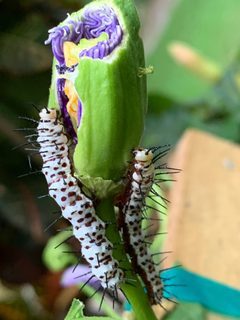
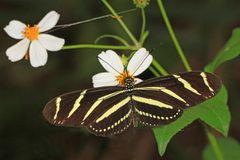
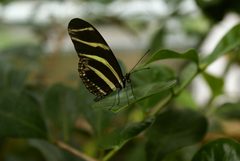
are and medium-sized with elongated wings. Wingspan ranges from 72 to 100 mm. wing surface is black with narrow white and yellow longitudinal stripes; surface shows similar pattern but paler with additional red spots. Caterpillars are white with black spots and numerous black spines along the body.
Distribution
Native to South America, Central America, the West Indies, Mexico, and the southeastern United States. Northern range extends to southern Texas and peninsular Florida. Seasonal occur northward into New Mexico, South Carolina, and Nebraska during warmer months.
Diet
feed on pollen and nectar. Larvae feed exclusively on passionflower vines (Passiflora spp.), including Passiflora lutea, P. suberosa, P. biflora, P. adenopoda, P. rubra, P. incarnata, and P. suberosa.
Host Associations
- Passiflora - larval multiple used including P. lutea, P. suberosa, P. biflora, P. adenopoda, P. rubra, P. incarnata
Life Cycle
Complete with five larval instars. Larval survival varies by plant (76.4% on P. adenopoda versus 33.9% on P. rubra). Pupal mortality reaches 3% on P. rubra with zero mortality on P. adenopoda. longevity in captivity reaches 140 days on P. adenopoda versus 70 days on P. rubra.
Behavior
exhibit trap-lining , following defined routes through forests to visit pollen-bearing flowers. Communal roosting occurs nightly in groups averaging five individuals (optimal for deterrence), with groups up to 60 individuals documented. Pupal mating is characteristic: males locate and compete for access to female pupae, with copulation beginning before adult . Chemical communication via olfactory cues from damaged plants guides mate location.
Ecological Role
Pollen feeder contributing to nutrient cycling in tropical and subtropical . Larval herbivore on passionflower vines. Aposematic coloration serves as warning signal to . Communal roosting may influence predator learning and avoidance.
Human Relevance
Designated official state of Florida in 1996. Popular in butterfly houses and conservation education. Subject of scientific research on pollen feeding, chemical defense, and developmental plasticity in plant preferences.
Similar Taxa
- Heliconius atthisSimilar black and white striped wing pattern; distinguished by differences in stripe width and red spot placement on surface
Sources and further reading
- BugGuide
- Wikipedia
- GBIF taxonomy match
- iNaturalist taxon
- NCBI Taxonomy
- Catalogue of Life
- September | 2022 | Beetles In The Bush
- Arthropoda | Beetles In The Bush | Page 5
- science | Beetles In The Bush | Page 5
- predator avoidance | Beetles In The Bush
- Passionate about passion fruit - Zebra longwing butterflies, Heliconius charitonius — Bug of the Week
- Bugs in orange and black IV – Golden Helicon butterfly, Heliconius hecale; Queen Butterfly, Danaus gilipus; Woolly bear caterpillar, Isia isabella (NEED LINKS) — Bug of the Week
- Manipulation of natal host modifies adult reproductive behaviour in the butterflyHeliconius charithonia
- Development, Longevity, and Oviposition of Heliconius Charithonia (Lepidoptera: Nymphalidae) On Two Species Of Passiflora