
Memphis pithyusa
(Felder, 1869)
Pale-spotted Leafwing, Blue Leafwing
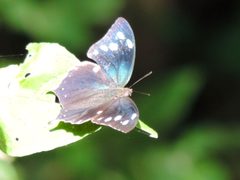
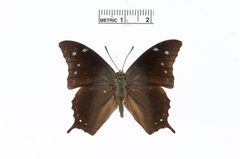
Memphis pithyusa is a leafwing in the Nymphalidae with a wingspan of 57–76 mm. The exhibits strong , with females notably larger than males. It displays seasonal , with distinct dry and wet season forms. The underside of the wings is cryptically colored to resemble a dead leaf, while the upper surface shows dark blue to brown coloration with light spots. It is the smallest member of its species group.
Pronunciation
How to pronounce Memphis pithyusa: /ˈmɛmfɪs pɪˈθjuːsə/
These audio files are automatically generated. While they are not always 100% accurate, they are a good starting point.
Identification
Distinguished from similar , particularly Memphis lemnos, by less deeply sinuous and margins of the forewings, resulting in a less projecting inner angle and less pronounced apex. Smallest species in its group. Females distinguished by larger size, bluer wing bases, and larger mostly white forewing spots compared to males.
Images
Appearance
Medium-sized with wingspan 57–76 mm. Forewings have a concave outer edge; hindwings bear a tail. Upper surface dark blue to brown with lighter blue or blue-green basal area and submarginal line of light dots. Underside light brown, dead leaf mimic. present: females substantially larger than males, with bluer wing bases and larger, mostly white spots on forewings.
Habitat
Various forest types.
Distribution
Southern North America and South America: South Texas, Mexico, Rica, Colombia, Bolivia, Guyana, and French Guiana. Memphis pithyusa pithyusa in Mexico and Colombia; M. p. morena in French Guiana.
Seasonality
Dry season form active May to September; wet season form active November to March.
Diet
diet not documented. Larvae feed on Croton (Euphorbiaceae), specifically Croton reflexifolius and Croton lucidus.
Host Associations
- Croton reflexifolius - larval plantEuphorbiaceae
- Croton lucidus - larval plantEuphorbiaceae
Life Cycle
Seasonal produces distinct dry season and wet season forms. Complete with documented larval plant associations.
Behavior
Dead leaf mimicry on wing underside, likely serving as anti- camouflage when at rest.
Ecological Role
; herbivore as larva on Croton .
Human Relevance
Subject of entomological study; assigned MONA/Hodges number 4556.
Similar Taxa
- Memphis lemnosSimilar overall appearance; distinguished by more deeply sinuous forewing margins and larger size