
Strephonota tephraeus
(Geyer, 1837)
Pearly-gray Hairstreak
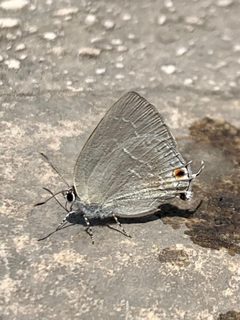
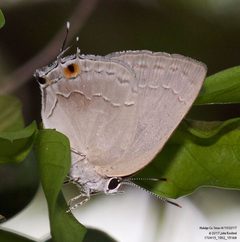
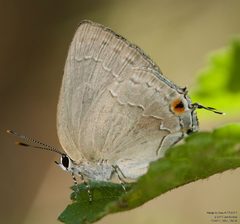
Strephonota tephraeus is a small lycaenid with a wingspan of 22–29 mm, commonly known as the Pearly-gray . The ranges from Mexico through Central America to the Amazon basin and northern South America, with rare vagrant records in southern Texas. It inhabits lowland tropical forests, particularly riparian corridors, and exhibits multivoltine breeding in Mexico with active from May through December.
Pronunciation
How to pronounce Strephonota tephraeus: //strɛˈfoʊnoʊtə tɛˈfriːəs//
These audio files are automatically generated. While they are not always 100% accurate, they are a good starting point.
Identification
Distinguished from other hairstreaks by its small size (22–29 mm wingspan) and pearly-gray coloration. Geographic range helps separate it from similar North American hairstreaks; in the lower Rio Grande Valley, it may be confused with resident but occurs only as rare strays in November. Specific diagnostic wing patterns require reference to specialized lycaenid literature.
Images
Appearance
Small with wingspan 22–29 mm. The 'Pearly-gray ' suggests grayish coloration with possible iridescent or pearly scaling, typical of many hairstreaks in the Lycaenidae. Detailed wing pattern description is not available in sources.
Habitat
Lowland tropical forests, with strong association to riparian corridors and riverine environments. The shows preference for forested near watercourses rather than open or disturbed areas.
Distribution
Mexico to Venezuela, the Amazon basin, the Guianas, and Peru. Rare vagrant individuals documented in the lower Rio Grande Valley of southern Texas, USA.
Seasonality
Multivoltine in Mexico with period from May to December. Adults recorded in November in southern Texas. Specific for South American not documented.
Diet
: presumably flower nectar (inferred from -level traits, specific records lacking). Larval plants unknown.
Life Cycle
Multiple per year in Mexico. Complete developmental stages (, larva, pupa, ) typical of Lycaenidae, but specific details unrecorded.
Human Relevance
Subject of interest for lepidopterists due to its restricted northern range in the United States; rare Texas records attract observation efforts. No known agricultural or economic significance.
Similar Taxa
- Other Strephonota species-level similarity in size and general ; identification to level requires examination of genitalia or detailed wing pattern analysis
- North American hairstreaks (Satyrium, Parrhasius, etc.)Similar small size and '' ; S. tephraeus distinguished by gray rather than brown or coppery coloration and by its extreme rarity in Texas versus resident status of native
More Details
Vagrancy pattern
The Texas records represent the northernmost extent of the ' range and are considered rare strays rather than established , likely resulting from events during favorable conditions.
Taxonomic authority
Original description by Geyer in 1837, placing this among the earlier described Neotropical lycaenids.