
Panthiades
Hübner, 1819
Species Guides
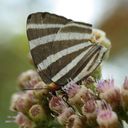
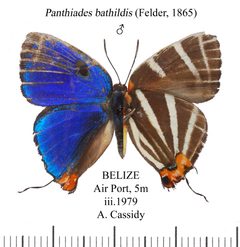
1- Panthiades bathildis(Zebra-striped Hairstreak)
Panthiades is a of lycaenid butterflies in the tribe Eumaeini (hairstreaks). The genus comprises approximately eight described distributed throughout the Neotropical region. At least one species, Panthiades bitias, has been documented as myrmecophilous, with stages exhibiting -associated . are generally small to medium-sized butterflies with the characteristic of butterflies.
Pronunciation
How to pronounce Panthiades: /ˈpænθiˌeɪdiːz/
These audio files are automatically generated. While they are not always 100% accurate, they are a good starting point.
Identification
Members of Panthiades can be distinguished from related Eumaeini by genitalic characters and wing pattern details, though specific diagnostic features require examination of and reference to Nicolay's 1976 revision. The genus is placed in the tribe Eumaeini based on morphological and molecular evidence. -level identification relies on wing pattern elements including markings on the hindwing margins and coloration.
Images
Distribution
, including Central and South America. occurrence records span from Mexico through Central America to South America, with individual species having more restricted ranges within this broader region.
Behavior
Myrmecophilous associations have been documented in Panthiades bitias, where stages interact with ants. The specific nature of these interactions (whether facultative or obligate mutualism) requires further study.
Similar Taxa
- CycnusHistorically confused with Panthiades; both were reviewed together by Nicolay (1976) and share similar wing patterns and genitalic structure, requiring careful examination for separation.
- Other Eumaeini generaMany share the characteristic tail-like hindwing projections and similar size; definitive separation requires genitalic dissection and reference to taxonomic revisions.