
Callophrys hesseli
(Rawson & Ziegler, 1950)
Hessel's Hairstreak
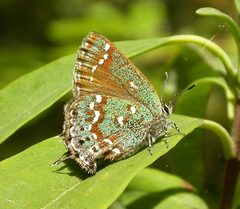
Hessel's is a small lycaenid to Atlantic coastal wetlands of the eastern United States. The exhibits complete ecological dependence on Atlantic white-cedar (Chamaecyparis thyoides), which serves as the exclusive larval plant and provides camouflage . are patchily distributed and declining due to habitat loss, with state-level endangered status in Connecticut and G3 vulnerable ranking globally.
Pronunciation
How to pronounce Callophrys hesseli: /kəˈlɒfrɪs ˈhɛsɛlaɪ/
These audio files are automatically generated. While they are not always 100% accurate, they are a good starting point.
Identification
Distinguished from other Callophrys hairstreaks by combination of: (1) olive green and rusty brown wing coloration with white marginal bands, (2) exclusive association with Atlantic white-cedar wetlands, (3) Atlantic coastal plain distribution. Similar Juniper Hairstreak (Callophrys gryneus) occurs on eastern red cedar in different and lacks the rusty brown base color. Henry's (Callophrys henrici) uses different plants (various hollies).
Images
Habitat
Strictly confined to terrestrial wetlands supporting Atlantic white-cedar: Atlantic white-cedar swamps, bogs, riparian wetlands, and forested wetlands. Requires mature cedar stands with sufficient structure for perching and mating.
Distribution
Atlantic coastal plain from southern Maine south to Florida Panhandle. Core in New Jersey. Estimated 21–300 total, with only 13–125 considered stable. Extirpated from New York (surveys in 1990s found none).
Seasonality
active in May. laid in early May, hatch after 4–6 weeks. Larvae feed through growing season, enter pupal during winter. Adult lifespan 1–2 weeks.
Diet
Larvae feed exclusively on foliage of Atlantic white-cedar (Chamaecyparis thyoides). consume nectar from: swamp milkweed (Asclepias incarnata), shadbush (Amelanchier), sand myrtle (Kalmia buxifolia), sweet pepperbush (Clethra alnifolia), highbush blueberry (Vaccinium corymbosum), buttonbush (Cephalanthus occidentalis), and dogbane (Apocynum).
Host Associations
- Chamaecyparis thyoides - exclusive larval Atlantic white-cedar; complete dependence
Life Cycle
stage (4–6 weeks, early May). Larval stage (herbivorous, feeding on cedar foliage). Pupal stage ( ). stage (nectarivorous, 1–2 week lifespan). Eggs deposited on branch tips of Atlantic white-cedar to ensure immediate food availability for emerging larvae.
Behavior
perch on cedar tree tops, shifting position in response to sunlight levels. When disturbed, groups disperse in swirling . Males aggregate at tree tops to scout for females; females remain at lower levels until mating season. Males compete for female attention in -like at midday. Courtship, mating, and oviposition occur during midday period on cedar trees.
Ecological Role
Specialized herbivore tightly coevolved with Atlantic white-cedar. Serves as for intact cedar swamp . Larval feeding has minimal impact on trees due to low densities and lack of competition in specialized .
Human Relevance
Conservation concern due to loss. Listed as endangered in Connecticut. Protected under MESA in Massachusetts. Subject to monitoring programs in New Jersey where sightings inform conservation planning. Named in honor of lepidopterist Sidney Adolphus Hessel.
Similar Taxa
- Callophrys gryneusJuniper Hairstreak; similar green coloration but uses Juniperus , occurs in different , lacks rusty brown wing base
- Callophrys henriciHenry's ; uses Ilex , different and distribution
More Details
Conservation Status
G3 vulnerable globally; endangered in Connecticut. Primary threats: logging of Atlantic white-cedar stands, wetland drainage, wildfire, hurricane damage, deer browse preventing forest recovery, and competition from spongy moth (Lymantria dispar) larvae. Estimated 30–70% decline. Protected to varying degrees in Maine, Massachusetts, Rhode Island, Virginia, Florida, and New Jersey.
Population Biology
Many suitable lack butterflies, suggesting local extirpation from historical logging and use. Patchy distribution with unexplained absences in apparently suitable habitat.