
Callophrys gryneus nelsoni
(Boisduval, 1869)
Nelson's Hairstreak, Nelson's Juniper Hairstreak
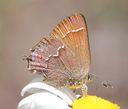
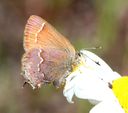
Callophrys gryneus nelsoni is a western North American of juniper hairstreak . Its taxonomic status has been debated, with some authorities treating it as a distinct subspecies while others have elevated it to full rank as Mitoura nelsoni. barcode studies indicate it is genetically divergent from other C. gryneus , though the magnitude of divergence is comparable to that seen between other recognized species in the . are associated with juniper woodlands.
Pronunciation
How to pronounce Callophrys gryneus nelsoni: //kæˈlɒfrɪs ˈɡrɪniəs nɛlˈsoʊni//
These audio files are automatically generated. While they are not always 100% accurate, they are a good starting point.
Identification
Distinguished from other C. gryneus by phenotypic differences and geographic range; western show genetic divergence in COI barcodes. The occurs in the western portion of the ' range, separated from eastern populations. Specific wing pattern differences from nominate C. g. gryneus and other subspecies require detailed examination and are not clearly documented in available sources.
Images
Habitat
Associated with juniper woodlands; specifically observed in pinyon-juniper/oak woodland transition zones at elevations around 7000 ft.
Distribution
Western North America; specifically recorded from the Kaibab Plateau region of north-central Arizona (Coconino County) and presumably ranging more broadly across the southwestern United States where juniper occur.
Seasonality
have been observed in early June, suggesting late spring to early summer period. The observation at 7000 ft elevation in early June indicates activity begins after snowmelt at higher elevations.
Host Associations
- Juniperus osteosperma - probable larval Utah juniper; inferred from occurrence in pinyon-juniper woodland and known associations of related C. gryneus , though direct larval records for this are not documented
Behavior
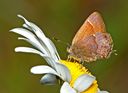
have been observed visiting flowers of Hymenopappus filifolia (fine-leaved hymenopappus) for nectar. Activity appears or early morning, with adults becoming more difficult to approach as temperatures rise.
Similar Taxa
- Callophrys gryneus gryneusEastern ; nelsoni separated by geographic range and genetic divergence in COI barcodes
- Callophrys gryneus sivaWestern ; genetic studies indicate comparable divergence between nelsoni and siva as between nelsoni and nominate gryneus, contributing to taxonomic controversy
- Callophrys muiriCalifornia ; barcode data suggest comparable genetic divergence to that between nelsoni and other gryneus , raising questions about species boundaries in the complex
Sources and further reading
- BugGuide
- GBIF taxonomy match
- iNaturalist taxon
- Chrysididae | Beetles In The Bush
- Bug Eric: May 2023
- Bug Eric: City Nature Challenge 2023 Recap
- Performance of DNA barcodes for informing the subspecies controversy in North American populations of Callophrys gryneus (Hübner, [1819]) (Lepidoptera: Lycaenidae)